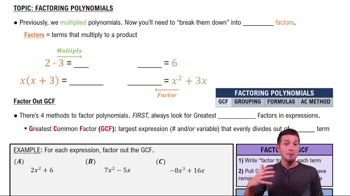
Factoring is the process of breaking down a complicated polynomial expression into simpler expressions (factors) that multiply to give the original expression.
What is the Greatest Common Factor (GCF) in a polynomial?
The GCF is the largest expression that evenly divides all terms in a polynomial.
How do you check if you factored out the GCF correctly?
You can check by distributing the GCF back into the factored expression; you should get the original polynomial.
When should you use factoring by grouping?
Use factoring by grouping when the polynomial has four terms and no single GCF for all terms.
What is the first step in factoring by grouping?
The first step is to group the polynomial into two pairs, usually the first two and the last two terms.
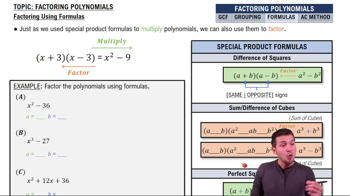
What pattern does the difference of squares formula follow?
The difference of squares follows the pattern a^2 - b^2 = (a + b)(a - b).
How do you factor x^2 - 36 using special product formulas?
Recognize it as a difference of squares: x^2 - 36 = (x + 6)(x - 6).
What is the formula for factoring a difference of cubes?
The formula is a^3 - b^3 = (a - b)(a^2 + ab + b^2).
How do you identify a perfect square trinomial?
A perfect square trinomial fits the pattern a^2 + 2ab + b^2 or a^2 - 2ab + b^2.
What is the AC method used for?
The AC method is used to factor trinomials of the form ax^2 + bx + c, especially when a = 1.
What do you look for when using the AC method?
You look for two numbers that multiply to ac and add to b.
How do you factor trinomials when a ≠ 1 using the AC method?
After finding two numbers that multiply to ac and add to b, rewrite the middle term as two terms and factor by grouping.
Why can't you always use the guess and check method for factoring trinomials?
Guess and check can be inefficient and unreliable, especially when a ≠ 1, so systematic methods like the AC method are preferred.
What is the key sign pattern in the difference of cubes and sum of cubes formulas?
The signs in the binomial and trinomial factors follow a specific pattern: for a^3 - b^3, it's (a - b)(a^2 + ab + b^2); for a^3 + b^3, it's (a + b)(a^2 - ab + b^2).
What should you do if a trinomial does not fit any special product formula?
If it doesn't fit a special product formula, use the AC method or factoring by grouping, depending on the form of the polynomial.
 Back
Back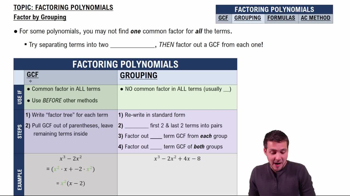
 04:36
04:36