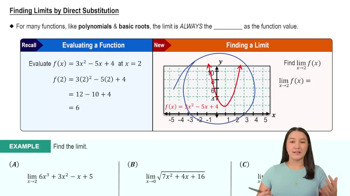
What is the direct substitution method for finding limits?
Direct substitution involves plugging the value that x approaches directly into the function to evaluate the limit, as long as the function is defined at that point.
For which types of functions does direct substitution always work to find limits?
Direct substitution always works for polynomials and basic root functions, as the limit equals the function value at the point unless the function is undefined there.
What must you check before using direct substitution on a rational function?
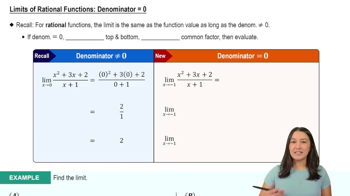
You must check that the denominator does not equal zero at the point of interest; if it does, direct substitution cannot be used.
What is the first step if direct substitution gives a denominator of zero in a rational function?
The first step is to factor both the numerator and denominator to look for common factors that can be canceled.
After factoring a rational function with a zero denominator, what should you do next?
You should cancel out any common factors between the numerator and denominator, then try direct substitution again.
How do you handle limits of rational functions with radicals when the denominator is zero?
Multiply both the numerator and denominator by the conjugate of the radical expression to simplify and eliminate the zero denominator.
What is a conjugate in the context of simplifying limits with radicals?
A conjugate is formed by changing the sign between two terms in a radical expression, such as turning (√x - √2) into (√x + √2).
Why do you multiply by the conjugate when simplifying limits with radicals?
Multiplying by the conjugate helps eliminate the radical and creates a common factor that can be canceled, allowing the limit to be evaluated.
What do you do after canceling common factors when simplifying a limit?
After canceling, substitute the value of x into the simplified expression to find the limit, provided the denominator is no longer zero.
If a rational function’s denominator is not zero at the point of interest, what is the limit?
The limit is simply the function value at that point, found by direct substitution.
What is the limit of 6x^3 + 3x^2 - x + 5 as x approaches 2?
The limit is 63, found by plugging x = 2 directly into the function.
How do you find the limit of (x^2 + 3x + 2)/(x + 1) as x approaches 0?
Plug x = 0 into the function to get 2/1, so the limit is 2.
What is the process for finding the limit of (x^2 + 3x + 2)/(x + 1) as x approaches -1?
Factor numerator and denominator, cancel (x + 1), then substitute x = -1 into the simplified expression to get the limit.
When simplifying (x - 2)/(√x - √2) as x approaches 2, what is the final answer?
After multiplying by the conjugate and simplifying, the limit is 2√2.
What is the limit of (√(x + 9) - 3)/x as x approaches 0?
After multiplying by the conjugate and simplifying, the limit is 1/6.
 Back
Back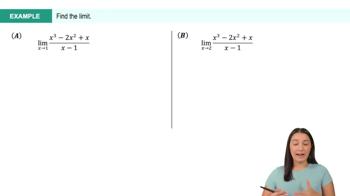
 03:17
03:17