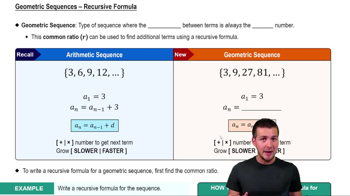
What is the next term in the geometric sequence 9, 3, 1, 1/3?
The next term is 1/9, found by multiplying the previous term by the common ratio 1/3.
How do you find the common ratio of a geometric sequence?
Divide any term in the sequence by the previous term; the result is the common ratio r.
What is a geometric sequence?
A geometric sequence is a sequence in which each term after the first is found by multiplying the previous term by a constant called the common ratio.
How do you find the nth term of a geometric sequence?
Use the formula A_n = A_1 * r^(n-1), where A_1 is the first term and r is the common ratio.
Given a geometric sequence defined recursively by g_n = g_{n-1} · (−2) and g_3 = 20, how do you find the 7th term?
First, work backwards to find g_2 and g_1, then use the recursive formula or the general formula g_n = g_1 * (−2)^(n−1) to find g_7.
How can you determine if a sequence is geometric?
A sequence is geometric if the ratio between any term and its previous term is always the same constant.
How does the growth rate of geometric sequences compare to arithmetic sequences?
Geometric sequences grow much faster than arithmetic sequences because they increase exponentially rather than linearly. This is due to multiplying by a constant ratio instead of adding a constant difference.
What two pieces of information are needed to write the general formula for a geometric sequence?
You need the first term of the sequence and the common ratio. These allow you to use the formula A_n = A_1 * r^(n-1).
Why is the general formula preferred over the recursive formula for finding high-index terms in a geometric sequence?
The general formula allows you to directly calculate any term without knowing previous terms. This is much more efficient for large indices than repeatedly applying the recursive formula.
What operation is used to generate terms in a geometric sequence, and how does this differ from arithmetic sequences?
Terms in a geometric sequence are generated by multiplying by a constant ratio. In contrast, arithmetic sequences use addition of a constant difference.
 Back
Back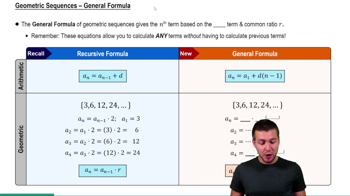
 04:45
04:45