A vector has both magnitude and direction, while a scalar has only magnitude and no direction.
How are vectors visually represented?
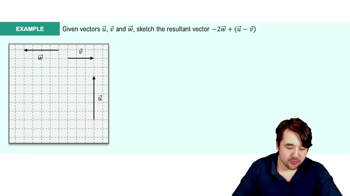
Vectors are visually represented as arrows, with the tail as the initial point and the tip as the terminal point.
What does the length of a vector represent?
The length of a vector represents its magnitude.
How is the direction of a vector determined?
The direction of a vector is determined by the angle at which the arrow points.
What is a negative vector?
A negative vector has the same magnitude as the original but points in the opposite direction.
What is the zero vector?
The zero vector has a magnitude of zero and no direction.
Describe the tip-to-tail method for vector addition.
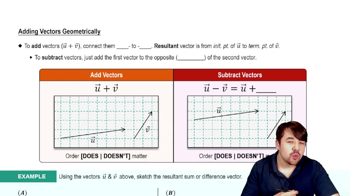
The tip-to-tail method involves connecting the tip of one vector to the tail of another and drawing the resultant vector from the initial point to the terminal point.
How do you subtract one vector from another?
Subtracting a vector is the same as adding its negative; you reverse the direction of the vector being subtracted and use the tip-to-tail method.
Does the order of addition matter when adding vectors?
No, the order does not matter; vector addition is commutative.
Does the order of subtraction matter when subtracting vectors?
Yes, the order matters; vector subtraction is not commutative and gives different results depending on the order.
What is a scalar in the context of vectors?
A scalar is a number with magnitude but no direction, such as 3 or -100.
What happens when you multiply a vector by a positive scalar?
Multiplying a vector by a positive scalar stretches or shrinks its magnitude while keeping its direction the same.
What effect does multiplying a vector by a negative scalar have?
Multiplying by a negative scalar changes the magnitude and reverses the direction of the vector.
How can you represent adding a vector to itself multiple times?
Adding a vector to itself multiple times is equivalent to multiplying the vector by a scalar equal to the number of times added.
How do you find half of a vector?
To find half of a vector, multiply each component of the vector by 1/2, which shrinks its magnitude by half.
 Back
Back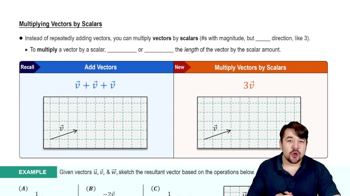
 05:05
05:05