Skip to main content
Precalculus
My Course
Learn
Exam Prep
AI Tutor
Study Guides
Flashcards
Explore
Try the app
My Course
Learn
Exam Prep
AI Tutor
Study Guides
Flashcards
Explore
Try the app
Back
Graphing Polynomial Functions quiz
You can tap to flip the card.
What is the first step in graphing a polynomial function?
You can tap to flip the card.
👆
What is the first step in graphing a polynomial function?
The first step is to determine the end behavior by analyzing the leading coefficient and degree of the polynomial.
Track progress
Control buttons has been changed to "navigation" mode.
1/15
Related flashcards
Related practice
Recommended videos
Graphing Polynomial Functions definitions
Graphing Polynomial Functions
13 Terms
Graphing Polynomial Functions
4. Polynomial Functions
2 problems
Topic
Understanding Polynomial Functions
4. Polynomial Functions
5 problems
Topic
4. Polynomial Functions
3 topics
7 problems
Chapter
Guided course
05:25
Graphing Polynomial Functions
1513
views
52
rank
Guided course
05:01
Identifying Intervals of Unknown Behavior
2162
views
45
rank
Guided course
09:43
Example 1
1269
views
39
rank
Terms in this set (15)
Hide definitions
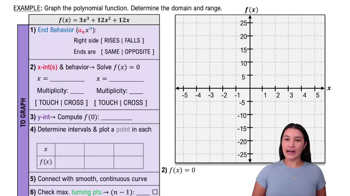
What is the first step in graphing a polynomial function?
The first step is to determine the end behavior by analyzing the leading coefficient and degree of the polynomial.
How do you find the x-intercepts of a polynomial function?
Set f(x) = 0 and solve for x, often by factoring the polynomial.
What does the multiplicity of an x-intercept tell you about the graph?
Multiplicity indicates whether the graph crosses or touches the x-axis at that intercept; odd multiplicity means it crosses, even means it touches.
How do you find the y-intercept of a polynomial function?
Evaluate f(0) by plugging x = 0 into the polynomial.
What is the end behavior of the function 2x^3 - 6x^2 + 6x - 2?
Since the leading coefficient is positive and the degree is odd, the graph rises to the right and falls to the left.
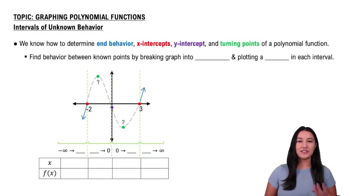
How do you determine intervals of unknown behavior when graphing a polynomial?
Divide the graph between known points such as intercepts and end behavior, creating intervals where the graph's behavior is uncertain.
Why is it important to plot points in intervals of unknown behavior?
Plotting points in these intervals helps clarify the graph's shape between known points and ensures accuracy.
What strategic x-values should you choose to plot in unknown intervals?
Choose x-values that are easy to plot and close to known points, avoiding extreme values that are hard to graph.
For the function 2x^3 - 6x^2 + 6x - 2, what are the x-intercepts and their behavior?
The x-intercept is at x = 1 with multiplicity 3, so the graph crosses the x-axis at this point.
What is the y-intercept for 2x^3 - 6x^2 + 6x - 2?
The y-intercept is at (0, -2).
How many turning points can a degree 3 polynomial have?
A degree 3 polynomial can have at most 2 turning points, which is degree minus 1.
What is the purpose of connecting plotted points with a smooth curve?
Connecting points with a smooth curve ensures the graph reflects the continuous nature and end behavior of the polynomial.
What should you check after graphing a polynomial function?
Check that the number of turning points does not exceed the maximum allowed by the degree and that the end behavior matches expectations.
What is a good x-value to plot in the interval from negative infinity to 0 for the function 2x^3 - 6x^2 + 6x - 2?
x = -1 is a strategic choice, and f(-1) = -16.
What is the result of plugging x = 3 into 2x^3 - 6x^2 + 6x - 2?
Plugging in x = 3 gives f(3) = 16, which is a point to plot in the interval from 1 to infinity.
 BackBack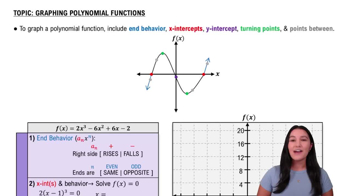
 05:25
05:25