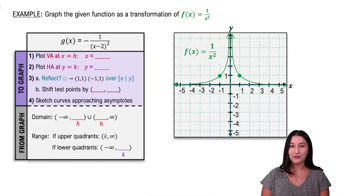
What is the general effect of the transformation h in the function g(x) = 1/(x-h) + k?
The transformation h shifts the graph horizontally by h units; the vertical asymptote moves to x = h.
How do you determine the vertical asymptote of a rational function?
Set the denominator equal to zero and solve for x; the solution(s) are the vertical asymptote(s).
What does the transformation k do in the function g(x) = 1/(x-h) + k?
The transformation k shifts the graph vertically by k units; the horizontal asymptote moves to y = k.
How do you find the horizontal asymptote when the degrees of the numerator and denominator are equal?
Divide the leading coefficient of the numerator by the leading coefficient of the denominator.
What is the domain of g(x) = 1/(x-3) + 1 in interval notation?
The domain is (-∞, 3) ∪ (3, ∞) because x = 3 is excluded.
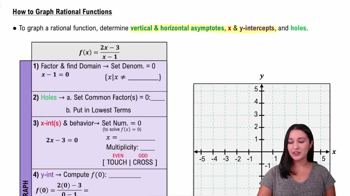
How do you find the x-intercept of a rational function?
Set the numerator equal to zero and solve for x, provided the denominator is not zero at that value.
What is the range of g(x) = 1/(x-3) + 1 in interval notation?
The range is (-∞, 1) ∪ (1, ∞) because y = 1 is excluded.
What does a negative sign outside the function indicate in terms of graph transformations?
A negative sign outside the function reflects the graph over the x-axis.
How do you determine if a rational function has a hole?
A hole occurs if there is a common factor in the numerator and denominator that can be canceled; set that factor equal to zero to find the x-value of the hole.
What is the y-intercept of the function f(x) = (2x-3)/(x-1)?
The y-intercept is found by plugging x = 0 into the function, giving f(0) = 3.
How do you decide the intervals to test when graphing a rational function?
Intervals are determined by the locations of vertical asymptotes and x-intercepts; test points are chosen within each interval.
What is the vertical asymptote of f(x) = (2x-3)/(x-1)?
The vertical asymptote is at x = 1.
How do you know if the graph crosses the x-axis at an x-intercept?
If the factor in the numerator corresponding to the x-intercept has odd multiplicity, the graph crosses the x-axis at that point.
What is the horizontal asymptote of f(x) = (2x-3)/(x-1)?
The horizontal asymptote is y = 2, since the degrees are equal and the leading coefficients are 2 and 1.
What is the process for sketching the graph after plotting asymptotes and key points?
Connect the plotted points with smooth curves that approach the asymptotes but never cross them, except possibly at x- or y-intercepts.
 Back
Back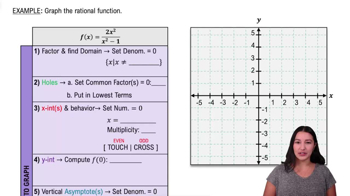
 10:18
10:18