Skip to main content
Precalculus
My Course
Learn
Exam Prep
AI Tutor
Study Guides
Flashcards
Explore
Try the app
My Course
Learn
Exam Prep
AI Tutor
Study Guides
Flashcards
Explore
Try the app
Back
Hyperbolas NOT at the Origin quiz
You can tap to flip the card.
What is the main difference in the equation of a hyperbola centered at the origin versus one not at the origin?
You can tap to flip the card.
👆
What is the main difference in the equation of a hyperbola centered at the origin versus one not at the origin?
The equation for a shifted hyperbola includes (x - h) and (y - k) instead of just x and y, where (h, k) is the new center.
Track progress
Control buttons has been changed to "navigation" mode.
1/15
Related flashcards
Related practice
Recommended videos
Hyperbolas NOT at the Origin definitions
Hyperbolas NOT at the Origin
15 Terms
Hyperbolas NOT at the Origin
19. Conic Sections
5 problems
Topic
Hyperbolas at the Origin
19. Conic Sections
4 problems
Topic
19. Conic Sections
6 topics
9 problems
Chapter
05:59
Graph Hyperbolas NOT at the Origin
604
views
9
rank
Terms in this set (15)
Hide definitions
What is the main difference in the equation of a hyperbola centered at the origin versus one not at the origin?
The equation for a shifted hyperbola includes (x - h) and (y - k) instead of just x and y, where (h, k) is the new center.
How do you identify the center (h, k) of a hyperbola from its equation?
The center (h, k) is found by looking at the values subtracted from x and y in the equation: (x - h) and (y - k).
How can you tell if a hyperbola is horizontal or vertical from its equation?
If the y-term comes first and is positive, the hyperbola is vertical; if the x-term comes first and is positive, it is horizontal.
What does the value 'a' represent in the equation of a hyperbola?
'a' is the square root of the first denominator and determines the distance from the center to each vertex along the transverse axis.
How do you find the vertices of a vertical hyperbola centered at (h, k)?
The vertices are at (h, k + a) and (h, k - a), where 'a' is the square root of the first denominator.
How do you find the vertices of a horizontal hyperbola centered at (h, k)?
The vertices are at (h + a, k) and (h - a, k).
What does the value 'b' represent in the equation of a hyperbola?
'b' is the square root of the second denominator and is used to find the 'b points' for drawing the rectangle that helps locate the asymptotes.
How do you find the 'b points' for a vertical hyperbola?
The 'b points' are at (h + b, k) and (h - b, k), where 'b' is the square root of the second denominator.
What is the purpose of drawing a rectangle (box) when graphing a hyperbola?
The rectangle connects the vertices and b points, and its diagonals are used to draw the asymptotes.
How do you find the equations of the asymptotes for a hyperbola not centered at the origin?
Draw lines through the corners of the rectangle (box) formed by the vertices and b points; these lines are the asymptotes.
What is the relationship between a, b, and c in a hyperbola?
The relationship is c² = a² + b², where 'c' is the distance from the center to each focus.
How do you find the coordinates of the foci for a vertical hyperbola centered at (h, k)?
The foci are at (h, k + c) and (h, k - c), where c = sqrt(a² + b²).
How do you find the coordinates of the foci for a horizontal hyperbola centered at (h, k)?
The foci are at (h + c, k) and (h - c, k).
What do the branches of a hyperbola do in relation to the asymptotes?
The branches approach the asymptotes but never cross them.
Why is it important to determine the orientation (horizontal or vertical) of a hyperbola before graphing?
The orientation determines the direction in which the vertices, b points, and foci are placed relative to the center.
 BackBack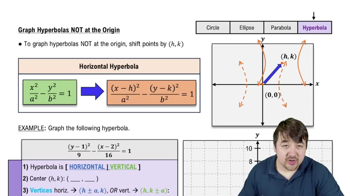
 05:59
05:59