Back

Linear Trigonometric Equations quiz

Control buttons has been changed to "navigation" mode.
1/15
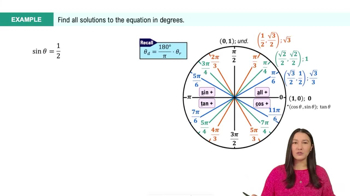
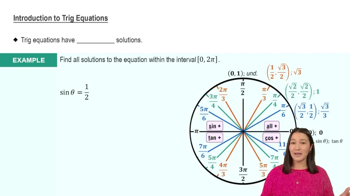
  • What are the solutions to sin(theta) = 1/2 within the interval 0 to 2pi?

    The solutions are theta = pi/6 and theta = 5pi/6.
  • How do you express all solutions to sin(theta) = 1/2 for any domain?

    All solutions are theta = pi/6 + 2pi*n and theta = 5pi/6 + 2pi*n, where n is any integer.
  • What is the solution to cos(x) = -1 on the unit circle?

    The solution is x = pi.
  • How do you write the general solution for cos(x) = -1?

    The general solution is x = pi + 2pi*n, where n is any integer.
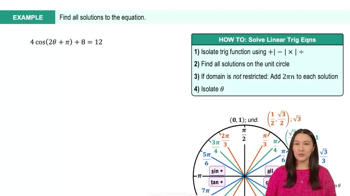
  • What is the first step in solving a linear trigonometric equation like 4*sin(theta) - 3 = 1?

    The first step is to use algebraic operations to isolate the trigonometric function.
  • After isolating sin(theta) in 4*sin(theta) - 3 = 1, what basic equation do you get?

    You get sin(theta) = 1.
  • What is the solution to sin(theta) = 1 within 0 to 2pi?

    The solution is theta = pi/2.
  • What is the first step in solving -2*cos(theta) + sqrt(3) = 0?

    Subtract sqrt(3) from both sides to isolate the cosine term.
  • After isolating cos(theta) in -2*cos(theta) = -sqrt(3), what do you do next?

    Divide both sides by -2 to get cos(theta) = sqrt(3)/2.
  • What are the solutions to cos(theta) = sqrt(3)/2 within 0 to 2pi?

    The solutions are theta = pi/6 and theta = 11pi/6.
  • How do you find all solutions to a trigonometric equation when the domain is unrestricted?

    Add 2pi*n to each solution, where n is any integer.
  • What does 2pi represent when finding all solutions to a trig equation?

    2pi represents a full rotation around the unit circle.
  • Why do trigonometric equations often have multiple solutions?

    Because the unit circle allows for multiple angles with the same sine or cosine value.
  • What should you do if the domain for a trig equation is restricted to 0 to 2pi?

    Only list the solutions within that interval and do not add 2pi*n.
  • What is the general method for solving linear trigonometric equations?

    Isolate the trig function using algebra, find solutions on the unit circle, and account for domain restrictions.