What does the FOIL acronym stand for when multiplying two binomials?
FOIL stands for First, Outer, Inner, Last, indicating the order in which to multiply the terms of two binomials.
Why can't the FOIL method be used to multiply a binomial by a trinomial?
FOIL only works for multiplying two binomials; with more terms, some products are left out, so you must use the distributive property instead.
How do you multiply a binomial by a trinomial using the distributive property?
Distribute each term of the binomial to every term in the trinomial, then combine like terms to simplify.
What is the result of multiplying (x+2)(x+3) using the FOIL method?
The result is x^2 + 5x + 6 after combining like terms.
What pattern can you use to check if you multiplied polynomials correctly before simplifying?
Multiply the number of terms in each polynomial; the product is the number of terms you should have before combining like terms.
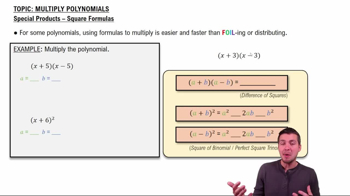
What is the special product formula for the difference of squares?
The formula is (A+B)(A−B) = A^2 − B^2.
When multiplying (x+5)(x−5), what is the simplified result using the difference of squares formula?
The result is x^2 − 25.
What is the special product formula for the square of a binomial (A+B)^2?
The formula is (A+B)^2 = A^2 + 2AB + B^2.
How do you expand (x+6)^2 using the special product formula?
It expands to x^2 + 12x + 36.
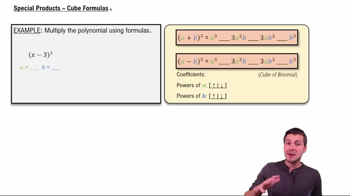
What is the special product formula for the cube of a binomial (A+B)^3?
The formula is (A+B)^3 = A^3 + 3A^2B + 3AB^2 + B^3.
How do the signs and coefficients differ in the expansion of (A−B)^3 compared to (A+B)^3?
In (A−B)^3, the signs alternate as negative, positive, negative, and the coefficients remain 1, 3, 3, 1.
What is the expanded form of (x−3)^3 using the special product formula?
It is x^3 − 9x^2 + 27x − 27.
What pattern do the coefficients follow in the expansion of cubes of binomials?
The coefficients follow the pattern 1, 3, 3, 1.
How do the powers of A and B change in the expansion of (A+B)^3?
The powers of A decrease from 3 to 0, while the powers of B increase from 0 to 3 across the terms.
Why is it efficient to use special product formulas when multiplying certain polynomials?
Special product formulas allow you to quickly expand and simplify expressions without performing all individual multiplications, reducing errors and saving time.
 Back
Back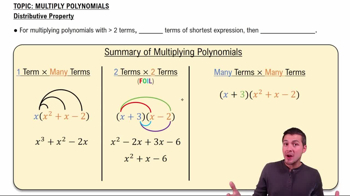
 04:15
04:15