Back

Probability quiz

Control buttons has been changed to "navigation" mode.
1/15
  • What is the difference between theoretical probability and empirical probability?

    Theoretical probability is based on possible outcomes before any events occur, while empirical probability is based on actual outcomes from experiments or collected data.
  • How do you calculate the theoretical probability of an event?

    Divide the number of outcomes that include the event by the total number of possible outcomes.
  • What is a sample space in probability?

    A sample space is the set of all possible outcomes of an experiment, often written in curly brackets.
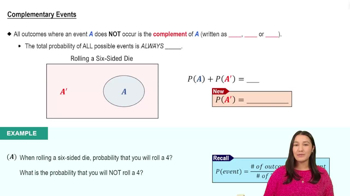
  • How do you find the probability of the complement of an event A?

    Subtract the probability of event A from 1; that is, P(A') = 1 - P(A).
  • What does it mean for two events to be mutually exclusive?

    Mutually exclusive events cannot occur at the same time; if one happens, the other cannot.
  • How do you calculate the probability of A or B for mutually exclusive events?

    Add the probabilities of each event: P(A or B) = P(A) + P(B).
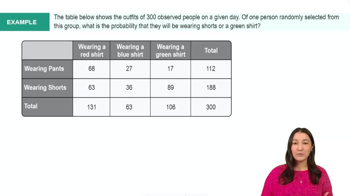
  • What adjustment must you make when calculating the probability of A or B for non-mutually exclusive events?

    Subtract the probability of both events occurring together: P(A or B) = P(A) + P(B) - P(A and B).
  • What does it mean for two events to be independent?

    Two events are independent if the outcome of one does not affect the outcome of the other.
  • How do you calculate the probability of A and B for independent events?

    Multiply the probabilities of each event: P(A and B) = P(A) × P(B).
  • If you flip a coin twice, what is the probability of getting heads both times?

    The probability is 1/2 × 1/2 = 1/4 or 0.25.
  • Why might empirical probability differ from theoretical probability in a small sample?

    Empirical probability may differ due to random variation in small samples, but it approaches theoretical probability as the sample size increases.
  • What is the probability of not drawing a queen from a standard deck of 52 cards?

    It is 1 minus the probability of drawing a queen: 1 - 4/52 = 48/52 or about 0.92.
  • If rolling a 6-sided die, what is the probability of rolling a 3 or a 5?

    Since these are mutually exclusive, add their probabilities: 1/6 + 1/6 = 1/3 or about 0.33.
  • When rolling a 6-sided die, what is the probability of rolling a number greater than 3 or an even number?

    Add the probabilities and subtract the overlap: 3/6 + 3/6 - 2/6 = 4/6 = 2/3 or about 0.67.
  • How do you find the probability of three independent events all occurring?

    Multiply the probabilities of all three events together.