Skip to main content
Precalculus
My Course
Learn
Exam Prep
AI Tutor
Study Guides
Flashcards
Explore
Try the app
My Course
Learn
Exam Prep
AI Tutor
Study Guides
Flashcards
Explore
Try the app
Back
Radians quiz
You can tap to flip the card.
What is the radian measure based on when measuring angles?
You can tap to flip the card.
👆
What is the radian measure based on when measuring angles?
The radian measure is based on the length of the radius of a circle wrapped around its circumference.
Track progress
Control buttons has been changed to "navigation" mode.
1/15
Related flashcards
Related practice
Recommended videos
Radians definitions
Radians
15 Terms
Radians
7. Measuring Angles
3 problems
Topic
Complementary and Supplementary Angles
7. Measuring Angles
7 problems
Topic
7. Measuring Angles
4 topics
8 problems
Chapter
5:04
Converting between Degrees & Radians
2807
views
109
rank
1
comments
Terms in this set (15)
Hide definitions
What is the radian measure based on when measuring angles?
The radian measure is based on the length of the radius of a circle wrapped around its circumference.
How many degrees are in a full circle?
A full circle is 360 degrees.
How many radians are in a full circle?
A full circle is 2π radians.
Approximately how many degrees is 1 radian?
1 radian is approximately 57 degrees.
What formula do you use to convert degrees to radians?
Multiply the degree measure by π/180 to convert to radians.
What formula do you use to convert radians to degrees?
Multiply the radian measure by 180/π to convert to degrees.
What is 120 degrees in radians?
120 degrees is 2π/3 radians.
What is 6π/5 radians in degrees?
6π/5 radians is 216 degrees.
If you go halfway around a circle, how many radians is that?
Halfway around a circle is π radians.
What is the radian measure for a quarter of a circle?
A quarter of a circle is π/2 radians.
What is the radian measure for three-quarters of a circle?
Three-quarters of a circle is 3π/2 radians.
When converting degrees to radians, which unit should be in the denominator?
Degrees should be in the denominator to cancel out the degree unit.
When converting radians to degrees, which unit should be in the denominator?
Radians (or π) should be in the denominator to cancel out the radian unit.
Why do we use radians instead of degrees in some math contexts?
Radians are often used in higher mathematics, especially with functions and graphing, because they relate directly to the properties of circles.
What two numbers are always involved in the conversion between degrees and radians?
The numbers π and 180 are always involved in the conversion formulas.
 BackBack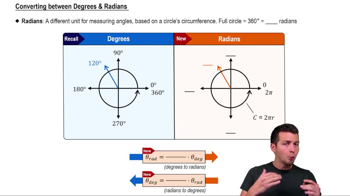
 5:04
5:04