Skip to main content
Precalculus
My Course
Learn
Exam Prep
AI Tutor
Study Guides
Flashcards
Explore
Try the app
My Course
Learn
Exam Prep
AI Tutor
Study Guides
Flashcards
Explore
Try the app
Back
The Square Root Property quiz
You can tap to flip the card.
When is factoring a good method for solving quadratic equations?
You can tap to flip the card.
👆
When is factoring a good method for solving quadratic equations?
Factoring is a good method when the quadratic equation has obvious factors or when the constant term is zero.
Track progress
Control buttons has been changed to "navigation" mode.
1/15
Related flashcards
Related practice
Recommended videos
The Square Root Property definitions
The Square Root Property
15 Terms
The Square Root Property
1. Equations and Inequalities
6 problems
Topic
Completing the Square
1. Equations and Inequalities
4 problems
Topic
1. Equations and Inequalities - Part 1 of 2
7 topics
13 problems
Chapter
1. Equations and Inequalities - Part 2 of 2
5 topics
12 problems
Chapter
Guided course
06:12
Solving Quadratic Equations by the Square Root Property
2019
views
47
rank
1
comments
Guided course
02:20
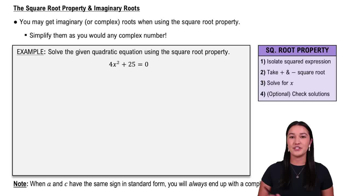
Imaginary Roots with the Square Root Property
1256
views
65
rank
1
comments
Terms in this set (15)
Hide definitions
When is factoring a good method for solving quadratic equations?
Factoring is a good method when the quadratic equation has obvious factors or when the constant term is zero.
What form must a quadratic equation be in to use the square root property?
The equation should have a squared term isolated and equal to a constant, or have no linear (x) term.
What is the first step when using the square root property to solve a quadratic equation?
The first step is to isolate the squared expression on one side of the equation.
Why do you take both the positive and negative square root when solving quadratics with the square root property?
Because both the positive and negative values squared will give the same result, so both are possible solutions.
Solve x + 1 squared equals 4 using the square root property.
x = 1 and x = -3.
How do you isolate the squared term in the equation 4x^2 - 5 = 0?
Add 5 to both sides and then divide by 4 to get x^2 = 5/4.
What are the solutions to x^2 = 5/4 using the square root property?
x = plus or minus the square root of 5 over 2 (x = ±√5/2).
Can solutions to quadratic equations using the square root property be fractions or radicals?
Yes, solutions can be fractions, radicals, or a combination of both.
What do you do if you get a negative number under the square root when solving a quadratic equation?
You express the solution using the imaginary unit i, resulting in a complex solution.
Solve 4x^2 + 25 = 0 using the square root property.
x = plus or minus 5i over 2 (x = ±5i/2).
What is a clue that a quadratic equation will have complex solutions when using the square root property?
If the coefficients a and c in the standard form have the same sign, the solutions will be complex.
What is the general process for solving a quadratic equation using the square root property?
Isolate the squared term, take the positive and negative square root of both sides, and solve for x.
Why might factoring not work for all quadratic equations?
Factoring doesn't work if the equation isn't factorable or doesn't have obvious factors.
What should you always remember to do after finding solutions using the square root property?
You should check your solutions by plugging them back into the original equation.
Is it acceptable for solutions to quadratic equations to include imaginary numbers?
Yes, it is acceptable and sometimes necessary when the equation leads to a negative under the square root.
 BackBack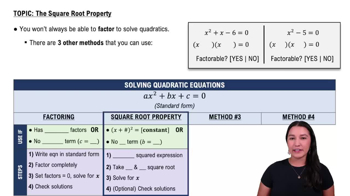
 06:12
06:12