Skip to main content
Precalculus
My Course
Learn
Exam Prep
AI Tutor
Study Guides
Flashcards
Explore
Try the app
My Course
Learn
Exam Prep
AI Tutor
Study Guides
Flashcards
Explore
Try the app
Back
Vectors in Component Form quiz
You can tap to flip the card.
What is a position vector?
You can tap to flip the card.
👆
What is a position vector?
A position vector is a vector whose initial point is at the origin of the graph.
Track progress
Control buttons has been changed to "navigation" mode.
1/15
Related flashcards
Related practice
Recommended videos
Vectors in Component Form definitions
Vectors in Component Form
15 Terms
Vectors in Component Form
14. Vectors
3 problems
Topic
Direction of a Vector
14. Vectors
3 problems
Topic
14. Vectors
6 topics
11 problems
Chapter
02:26
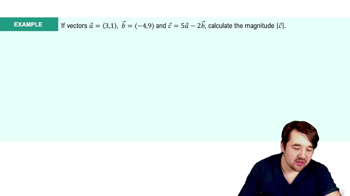
Finding Magnitude of a Vector Example 1
486
views
12
rank
03:11
Algebraic Operations on Vectors Example 1
463
views
14
rank
01:36
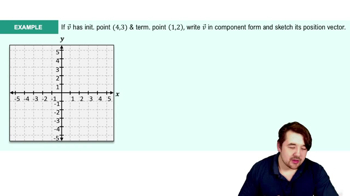
Position Vectors & Component Form Example 1
512
views
9
rank
Terms in this set (15)
Hide definitions
What is a position vector?
A position vector is a vector whose initial point is at the origin of the graph.
How do you write a vector in component form?
A vector in component form is written as (x, y), where x and y are the lengths in the x and y directions.
How do you find the component form of a vector given its initial and terminal points?
Subtract the initial point from the terminal point for both x and y: (x2 - x1, y2 - y1).
What does the x component of a vector represent?
The x component represents how far the vector moves in the x direction.
What does the y component of a vector represent?
The y component represents how far the vector moves in the y direction.
How do you calculate the magnitude of a vector in component form?
Use the formula: magnitude = sqrt(x^2 + y^2), where x and y are the vector's components.
Which theorem is used to find the magnitude of a vector?
The Pythagorean theorem is used to find the magnitude of a vector.
If a vector has components (4, 3), what is its magnitude?
Its magnitude is 5, since sqrt(4^2 + 3^2) = sqrt(16 + 9) = sqrt(25) = 5.
How do you add two vectors in component form?
Add their corresponding x components and y components: (x1 + x2, y1 + y2).
How do you subtract one vector from another in component form?
Subtract their corresponding components: (x1 - x2, y1 - y2).
What is the result of adding vectors (2, 3) and (3, -1)?
The result is (5, 2), since 2+3=5 and 3+(-1)=2.
How do you multiply a vector by a scalar?
Multiply each component of the vector by the scalar: k(x, y) = (kx, ky).
What is 3 times the vector (2, 4)?
It is (6, 12), since 3*2=6 and 3*4=12.
If v = (8, 5) and u = (2, 4), what is v - 3u?
First, 3u = (6, 12); then v - 3u = (8-6, 5-12) = (2, -7).
Why is mastering vector operations in component form important?
It is essential for further studies in mathematics and physics, as these operations are foundational for more advanced topics.
 BackBack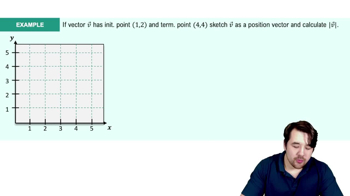
 02:26
02:26