Skip to main content
Introduction to Psychology
My Course
Learn
Exam Prep
AI Tutor
Study Guides
Flashcards
Explore
Try the app
My Course
Learn
Exam Prep
AI Tutor
Study Guides
Flashcards
Explore
Try the app
Back
Group Behavior definitions
You can tap to flip the card.
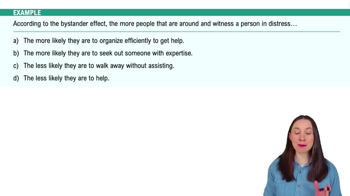
Bystander Effect
You can tap to flip the card.
👆
Bystander Effect
A phenomenon where the presence of others reduces the likelihood that any one person will help in an emergency.
Track progress
Control buttons has been changed to "navigation" mode.
1/15
Related flashcards
Related practice
Recommended videos
Group Behavior quiz
Group Behavior
15 Terms
Group Behavior
12. Social Psychology
7 problems
Topic
Nicole
Cognitive Dissonance
12. Social Psychology
7 problems
Topic
Nicole
12. Social Psychology - Part 1 of 2
3 topics
9 problems
Chapter
Nicole
12. Social Psychology - Part 2 of 2
3 topics
9 problems
Chapter
Nicole
Guided course
02:29
Deindividuation
282
views
4
rank
Guided course
01:03
Example 1
271
views
1
rank
Guided course
01:33
Example 2
279
views
4
rank
Terms in this set (15)
Hide definitions
Bystander Effect
A phenomenon where the presence of others reduces the likelihood that any one person will help in an emergency.
Diffusion of Responsibility
A psychological process where individuals feel less compelled to act because responsibility is shared among group members.
Deindividuation
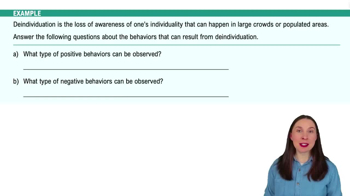
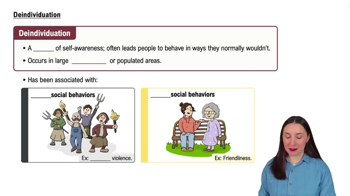
A state in which self-awareness diminishes, often leading to atypical behaviors in group settings.
Antisocial Behavior
Actions that violate societal norms or rules, often emerging in group contexts like mobs.
Prosocial Behavior
Actions intended to benefit others, such as increased friendliness, sometimes seen in group situations.
Self-Awareness
A sense of personal identity and consciousness that can decrease in large groups, influencing behavior.
Mob Violence
Destructive or aggressive acts carried out by crowds, often linked to reduced individual accountability.
Altruism
Selfless concern for others' well-being, which can override group-based hesitation to help.
Social Context
The surrounding environment and group dynamics that shape individual actions and decisions.
Expertise
Specialized knowledge or skills that increase the likelihood of intervention during emergencies.
Anonymity
A feeling of being unidentifiable in a group, which can alter typical behavior patterns.
Societal Norms
Shared expectations about acceptable conduct within a community or society.
Crowd
A large group of people gathered together, often influencing individual behavior through collective dynamics.
Emergency
A sudden, unexpected situation requiring immediate action, where group presence can affect responses.
Individuality
A sense of personal uniqueness that may diminish in group settings, impacting choices and actions.
 BackBack
 02:29
02:29