Skip to main content
Introduction to Psychology
My Course
Learn
Exam Prep
AI Tutor
Study Guides
Flashcards
Explore
Try the app
My Course
Learn
Exam Prep
AI Tutor
Study Guides
Flashcards
Explore
Try the app
Back
Information Processing Model definitions
You can tap to flip the card.
Information Processing Model
You can tap to flip the card.
👆
Information Processing Model
A framework comparing human memory to computer operations, emphasizing sequential stages of handling information.
Track progress
Control buttons has been changed to "navigation" mode.
1/14
Related flashcards
Related practice
Recommended videos
Information Processing Model quiz #1
Information Processing Model
22 Terms
Information Processing Model
7. Memory
7 problems
Topic
Nicole
Storage - The Three Box Model of Memory
7. Memory
7 problems
Topic
Nicole
7. Memory
2 topics
5 problems
Chapter
Nicole
Guided course
01:41
Information Processing Model Example 1
1024
views
13
rank
Guided course
01:49
Information Processing Model
1533
views
32
rank
Terms in this set (14)
Hide definitions
Information Processing Model
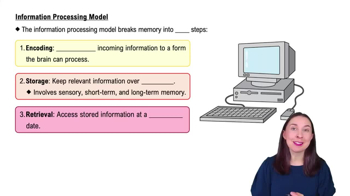
A framework comparing human memory to computer operations, emphasizing sequential stages of handling information.
Encoding
The transformation of sensory input into neural signals, allowing the brain to interpret and process data.
Storage
The maintenance of information over time within distinct memory systems, ensuring data is preserved for future use.
Retrieval
The process of accessing previously stored information, enabling recall and use of memories when needed.
Sensory Memory
A brief initial stage that holds incoming sensory information for a fraction of a second before further processing.
Short-Term Memory
A temporary storage system that retains limited information for a short duration, crucial for immediate tasks.
Long-Term Memory
A durable storage system capable of holding vast amounts of information for extended periods, supporting lasting recall.
Hippocampus
A brain structure essential for consolidating new memories, facilitating the transfer from short-term to long-term storage.
Consolidation
The process by which short-term memories are stabilized and integrated into long-term storage, enhancing retention.
Sensory Register
A component that briefly captures raw sensory data, acting as the gateway for information entering the memory system.
Working Memory
An active system for manipulating and managing information held temporarily, supporting reasoning and comprehension.
Long-Term Potentiation
A neural mechanism that strengthens synaptic connections, underlying the formation and retention of long-term memories.
Recall
The act of retrieving information from memory without external cues, demonstrating the effectiveness of retrieval processes.
Cognitive Processes
Mental activities involved in acquiring, storing, and using knowledge, fundamental to understanding memory and learning.
 BackBack
 01:41
01:41