Skip to main content
Introduction to Psychology
My Course
Learn
Exam Prep
AI Tutor
Study Guides
Flashcards
Explore
Try the app
My Course
Learn
Exam Prep
AI Tutor
Study Guides
Flashcards
Explore
Try the app
Back
Language Development definitions
You can tap to flip the card.
Phoneme
You can tap to flip the card.
👆
Phoneme
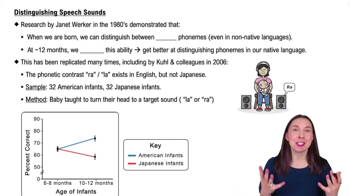
Smallest unit of sound in speech, which infants can initially distinguish across all languages before specializing in their native tongue.
Track progress
Control buttons has been changed to "navigation" mode.
1/15
Related flashcards
Related practice
Recommended videos
Language Development quiz #1
Language Development
33 Terms
Language Development
8. Cognition
7 problems
Topic
Nicole
The Structure of Language
8. Cognition
7 problems
Topic
Nicole
8. Cognition
2 topics
6 problems
Chapter
Nicole
Guided course
01:15
Language Development Example 2
730
views
5
rank
Guided course
03:03
Distinguishing Speech Sounds
1157
views
12
rank
Guided course
05:39
Language Milestones
936
views
9
rank
Terms in this set (15)
Hide definitions
Phoneme
Smallest unit of sound in speech, which infants can initially distinguish across all languages before specializing in their native tongue.
Neural Plasticity
Brain's capacity to adapt and reorganize, enabling infants to specialize in native language sounds during early development.
Sensitive Period
Optimal developmental window before puberty when language acquisition occurs most easily and fully.
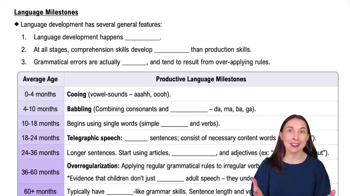
Cooing
Early vocalization stage in infants, marked by the production of simple vowel sounds without attached meaning.
Babbling
Stage where infants combine consonants and vowels, producing repetitive syllables without specific meaning.
Telegraphic Speech
Early speech phase using short, content-rich phrases that omit non-essential words but follow basic grammar.
Overregularization
Application of standard grammar rules to irregular words, revealing an emerging grasp of language structure.
Universal Grammar
Innate set of linguistic principles theorized to underlie all human languages, facilitating rapid language learning.
Operant Conditioning
Learning process where behaviors are shaped by reinforcement, proposed as a mechanism for language acquisition.
Infant-Directed Speech
Distinctive, melodic speech style used by adults to enhance clarity and aid language learning in young children.
Nicaraguan Sign Language
Emergent language developed by deaf children, illustrating innate grammatical abilities and the role of social interaction.
Comprehension Skills
Abilities related to understanding language, which typically develop faster than the ability to produce speech.
Production Skills
Abilities involved in generating spoken language, requiring coordination of speech organs and developing after comprehension.
Syntax
Rules governing the arrangement of words and phrases to create meaningful sentences, rapidly acquired in early childhood.
Vocabulary
Collection of words known and used, which expands rapidly during the first years of life as language skills develop.
 BackBack
 01:15
01:15