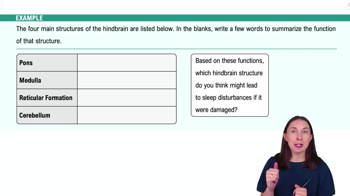
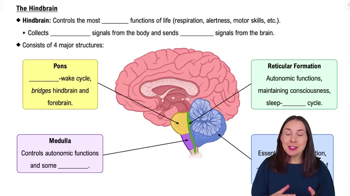
Region at the base of the brainstem responsible for basic survival functions, integrating sensory and motor signals between the spinal cord and forebrain.
Brainstem
Continuous structure connecting the spinal cord to the brain, housing vital centers for autonomic and reflexive functions.
Medulla
Structure controlling involuntary processes like breathing, heart rate, blood pressure, and basic reflexes such as coughing.
Pons
Upper hindbrain structure regulating the sleep-wake cycle, especially REM sleep, and serving as a bridge between brain regions.
Reticular Formation
Network running through the brainstem, crucial for maintaining consciousness, alertness, and autonomic functions.
Cerebellum
“Little brain” at the back of the brain, essential for coordination, balance, and timing of precise movements.
Autonomic Nervous System
System managing involuntary bodily functions such as respiration, heart rate, and blood pressure.
REM Sleep
Sleep stage characterized by rapid eye movement and dreaming, regulated by the pons.
Reflexes
Automatic, rapid responses to stimuli, such as coughing or sneezing, managed by the medulla.
Consciousness
State of awareness and alertness, maintained by the reticular formation within the hindbrain.
Motor Skills
Abilities involving precise movement and coordination, integrated by the cerebellum and hindbrain structures.
Sensory Input
Signals from the body relayed through the hindbrain to higher brain regions for processing.
Forebrain
Region receiving and sending signals via the hindbrain, involved in higher cognitive functions.
Spinal Cord
Main pathway for transmitting sensory and motor information between the body and brain, connected through the hindbrain.
 Back
Back
 05:18
05:18