Skip to main content
Introduction to Psychology
My Course
Learn
Exam Prep
AI Tutor
Study Guides
Flashcards
Explore
Try the app
My Course
Learn
Exam Prep
AI Tutor
Study Guides
Flashcards
Explore
Try the app
Back
Visual Anatomy definitions
You can tap to flip the card.
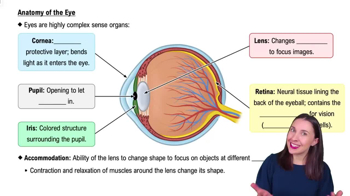
Cornea
You can tap to flip the card.
👆
Cornea
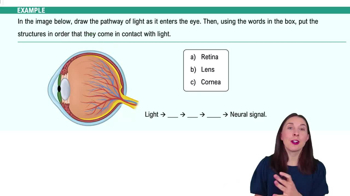
Outermost eye layer that shields against debris and bends incoming light to aid initial focusing.
Track progress
Control buttons has been changed to "navigation" mode.
1/14
Related flashcards
Related practice
Recommended videos
Visual Anatomy quiz #1
Visual Anatomy
11 Terms
Visual Anatomy
4. Sensation and Perception
7 problems
Topic
Nicole
Color Vision
4. Sensation and Perception
7 problems
Topic
Nicole
4. Sensation and Perception
3 topics
9 problems
Chapter
Nicole
Guided course
01:16
Visual Anatomy Example 1
1304
views
18
rank
Guided course
03:08
Anatomy of the Eye
1434
views
24
rank
Guided course
04:47
Photosensitive Cells
1189
views
22
rank
Terms in this set (14)
Hide definitions
Cornea
Outermost eye layer that shields against debris and bends incoming light to aid initial focusing.
Pupil
Central eye opening that determines the amount of light entering the interior structures.
Iris
Colored ring with muscles that adjust the pupil's size, regulating light entry.
Lens
Transparent structure behind the pupil that alters shape to focus images at varying distances.
Accommodation
Process involving lens shape change, enabling clear focus on objects at different distances.
Retina
Neural tissue lining the eye's back, housing light-sensitive cells that initiate visual signals.
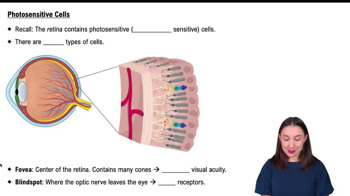
Rods
Peripheral, rod-shaped cells enabling monochromatic vision in dim environments; highly numerous.
Cones
Cone-shaped cells concentrated centrally, responsible for color vision and high acuity in bright light.
Fovea
Central retinal region densely packed with cones, providing the sharpest visual detail.
Optic Nerve
Bundle transmitting visual information from retinal cells to the brain for processing.
Blind Spot
Retinal area lacking receptors where the optic nerve exits, resulting in an unnoticed visual gap.
Photosensitive Cells
Specialized retinal elements, including rods and cones, that convert light into neural signals.
Visual Acuity
Degree of sharpness and detail discernible in vision, maximized at the fovea.
Periphery
Outer retinal region where rods are abundant, supporting vision in low-light conditions.
 BackBack
 01:16
01:16