Ch. R - Algebra Review
Lial - Trigonometry 12th Edition
Lial12th EditionTrigonometryISBN: 9780136552161Not the one you use?Change textbook
Chapter 1, Problem 29

Find each sum or difference. See Example 1. 9⁄10 - ( -4⁄3)

Verified step by step guidance
1
Recognize that the problem involves subtracting a negative fraction: \(\frac{9}{10} - \left(-\frac{4}{3}\right)\). Subtracting a negative is equivalent to adding the positive, so rewrite the expression as \(\frac{9}{10} + \frac{4}{3}\).
To add the fractions \(\frac{9}{10}\) and \(\frac{4}{3}\), find a common denominator. The denominators are 10 and 3, so the least common denominator (LCD) is the least common multiple of 10 and 3.
Calculate the least common multiple (LCM) of 10 and 3. Since 10 = 2 × 5 and 3 is prime, the LCM is \(2 \times 5 \times 3 = 30\). So, the common denominator is 30.
Convert each fraction to an equivalent fraction with denominator 30: multiply numerator and denominator of \(\frac{9}{10}\) by 3 to get \(\frac{27}{30}\), and multiply numerator and denominator of \(\frac{4}{3}\) by 10 to get \(\frac{40}{30}\).
Now add the fractions: \(\frac{27}{30} + \frac{40}{30} = \frac{27 + 40}{30} = \frac{67}{30}\). This is the sum expressed as an improper fraction.

Verified video answer for a similar problem:

This video solution was recommended by our tutors as helpful for the problem above.
Video duration:
3m
Was this helpful?

Key Concepts

Here are the essential concepts you must grasp in order to answer the question correctly.

Understanding of Fractions and Negative Numbers

Fractions represent parts of a whole, and operations with fractions require common denominators or direct arithmetic when possible. Negative numbers indicate values less than zero, and subtracting a negative number is equivalent to adding its positive counterpart.
Recommended video:
4:02
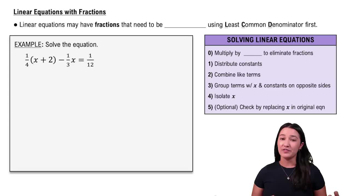
Solving Linear Equations with Fractions

Sum and Difference of Rational Numbers

Adding or subtracting rational numbers involves combining their values while considering their signs. When subtracting a negative fraction, it changes to addition, simplifying the operation to a sum of two positive fractions.
Recommended video:
4:47
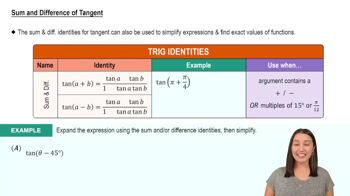
Sum and Difference of Tangent

Simplification of Fractions

After performing addition or subtraction, fractions should be simplified by finding the greatest common divisor of numerator and denominator. This ensures the fraction is expressed in its simplest form for clarity and correctness.
Recommended video:
4:02
Solving Linear Equations with Fractions