Ch. R - Algebra Review
Lial - Trigonometry 12th Edition
Lial12th EditionTrigonometryISBN: 9780136552161Not the one you use?Change textbook
Chapter 1, Problem 25

Find each square root. See Example 1. √-121

Verified step by step guidance
1
Recognize that the square root of a negative number involves imaginary numbers because the square root of a negative number is not defined in the set of real numbers.
Recall the definition of the imaginary unit \(i\), where \(i = \sqrt{-1}\), so \(\sqrt{-a} = i\sqrt{a}\) for any positive real number \(a\).
Rewrite the expression \(\sqrt{-121}\) as \(\sqrt{-1 \times 121}\) to separate the negative sign from the positive number.
Apply the property of square roots to write \(\sqrt{-121} = \sqrt{-1} \times \sqrt{121}\).
Substitute \(\sqrt{-1}\) with \(i\) and simplify \(\sqrt{121}\) to get the expression in terms of \(i\) and a real number.

Verified video answer for a similar problem:

This video solution was recommended by our tutors as helpful for the problem above.
Video duration:
3m
Was this helpful?

Key Concepts

Here are the essential concepts you must grasp in order to answer the question correctly.

Imaginary Numbers

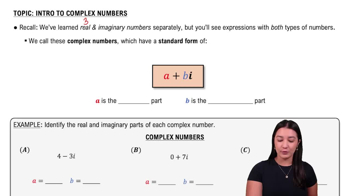
Imaginary numbers extend the real number system to include the square roots of negative numbers. The imaginary unit 'i' is defined such that i² = -1, allowing us to express √-121 as 11i.
Recommended video:
3:31
Introduction to Complex Numbers

Square Roots of Negative Numbers

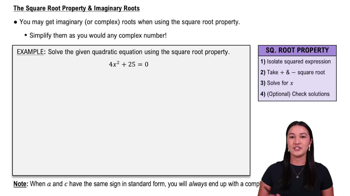
The square root of a negative number cannot be found within the real numbers. Instead, it is expressed using imaginary numbers, where √-a = √a × i for any positive real number a.
Recommended video:
2:20
Imaginary Roots with the Square Root Property

Simplifying Square Roots

Simplifying square roots involves factoring the number under the root into perfect squares and other factors. For example, √121 = 11, so √-121 = 11i by combining the imaginary unit with the simplified root.
Recommended video:
2:20
Imaginary Roots with the Square Root Property