Ch. 6 - Inverse Circular Functions and Trigonometric Equations
Lial - Trigonometry 12th Edition
Lial12th EditionTrigonometryISBN: 9780136552161Not the one you use?Change textbook
Chapter 7, Problem 73

Graph each inverse circular function by hand.
y = arcsec [(1/2)x]

Verified step by step guidance
1
Recall the definition of the inverse secant function: \(y = \arcsec(z)\) is the angle \(y\) such that \(\sec(y) = z\) and \(y\) lies in the principal range \([0, \pi]\) excluding \(\frac{\pi}{2}\).
Rewrite the given function as \(y = \arcsec\left(\frac{1}{2}x\right)\), which means \(\sec(y) = \frac{1}{2}x\).
Express \(x\) in terms of \(y\) by multiplying both sides by 2: \(x = 2 \sec(y)\).
Recall that \(\sec(y) = \frac{1}{\cos(y)}\), so \(x = \frac{2}{\cos(y)}\). This helps us understand the relationship between \(x\) and \(y\) for graphing.
To graph \(y = \arcsec\left(\frac{1}{2}x\right)\) by hand, choose values of \(y\) in the domain of \(\arcsec\) (i.e., \([0, \pi]\) excluding \(\frac{\pi}{2}\)), compute \(x = 2 \sec(y)\) for those values, and plot the points \((x, y)\). Connect these points smoothly, keeping in mind the vertical asymptotes where \(\cos(y) = 0\).

Verified video answer for a similar problem:

This video solution was recommended by our tutors as helpful for the problem above.
Video duration:
9m
Was this helpful?

Key Concepts

Here are the essential concepts you must grasp in order to answer the question correctly.

Inverse Circular Functions

Inverse circular functions, such as arcsec, are the inverse operations of the standard trigonometric functions restricted to specific domains. They return the angle whose trigonometric function equals a given value. Understanding their domain and range is essential for correctly graphing these functions.
Recommended video:
4:28
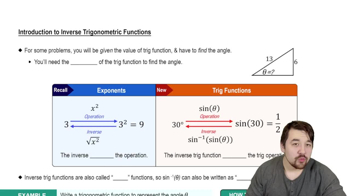
Introduction to Inverse Trig Functions

Domain and Range of arcsec(x)

The arcsec function is defined for inputs where the absolute value is greater than or equal to 1, since secant values lie outside the interval (-1,1). Its range is typically [0, π] excluding π/2. When the input is scaled, as in arcsec((1/2)x), the domain and range adjust accordingly and must be carefully determined before graphing.
Recommended video:
4:22
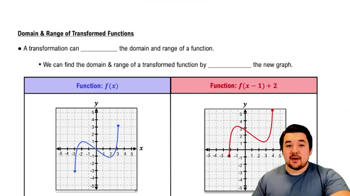
Domain and Range of Function Transformations

Graphing Transformations of Inverse Functions

Graphing y = arcsec((1/2)x) involves understanding how horizontal scaling affects the graph of y = arcsec(x). Multiplying the input by 1/2 stretches the graph horizontally by a factor of 2, changing the domain and the shape of the curve. Recognizing these transformations helps in sketching the graph accurately by hand.
Recommended video:
4:22
Domain and Range of Function Transformations