Effective classroom management routines for very young learners

Jeanne Perrett
Jeanne Perrett
A teacher with young students sitting at a table looking at flashcards
Reading time: 4 minutes

For very young learners, children aged 3-6, being in a classroom might be a completely new experience. Most of them won’t know any English words at all and might have very little idea of what English is or why they are learning it. Some of them may not yet be completely fluent in their mother tongue. 

At the beginning of the school year, some of them may find it distressing to be separated from their parents and they also have to learn to get along with their new classmates. 

If we want to keep them comfortable and safe and provide a friendly and welcoming environment, we need to establish routines. 

7 ways you can build routines into your classes

Here are some areas where you can easily incorporate classroom management routines into your English language class.

1. Think about your target language

Our target language for each lesson may be one or two short phrases or a few new words. We should always keep the presentation and practice of this simple and clear. 

However, we can use English for all our greetings, praise, instructions and explanations. After a few days, the children will begin to expect it and they will gradually understand what you are saying. 

2. Coming into the class

Take time to greet each child by name when they enter the classroom and encourage them to learn and use each other’s names too. This will change how they perceive themselves and each other and encourage friendly communication. 

Notice the small things about each child. They might have a new T-shirt on or have done their hair specially. They may not tell you that they have made an effort to look nice for their lesson, but they will be pleased when you notice and will feel encouraged to continue. 

3. Circle time

Make circle time the start of every lesson. It gets the children sitting down together and this helps them to get to know each other and feel part of a comfortable group. 

It’s the time where you present the target language for the day. Use a puppet to help you do this. Make the puppet part of the routine by keeping it in a certain place and bringing it out from there every day. The children can call its name. 

The puppet can greet the children by name and the children can answer back. First, use picture cards or objects to present the language to the puppet. Then, the puppet can show that it understands or ask for repetition. 

Let the children call out responses as a group. As they build their confidence in English they will want to speak by themselves. 

Always accept approximations of words and phrases. Rather than correcting the children, continue to model the words and gradually the students will self-correct. Pass this tip on to parents too. 

4. Book time

Give students time to discover pages and images they like in the books they are using. Always leave time to help each child find the correct page and then help them to focus their attention on that page. 

In Circle time you have introduced the language and presented it with flashcards or objects. In Book time, children can look at these images – the content will be familiar and they will start to feel ownership of what they are learning. 

5. Songs, games and miming

Singing, playing games and miming are the main ways in which the students will start to freely use and show they understand the target language. 

In My Disney Stars and Friends each stage of every game is detailed, along with the language you and the students can use. Students might become so involved in the action of the game that they forget to speak in English! That’s okay – continue using the language and eventually they will start to use it too. 

When a game or a song involves physical activity, have drinks of water ready and let them rest and relax afterwards. Always have a ‘sitting down’ activity ready for them to move on to so that they do not become overexcited or tired.

6. Craft and stickers

For any craft work there are four stages: preparation, production, playing with the completed craft work and tidying up. If you're using My Disney Stars and Friends, there is a special Tidy Up song and all the craft projects are press-outs so there is no need for scissors. 

Children of 3 or 4 years old will need to learn how to unpeel and then re-stick a sticker. Allow time for this and encourage them to learn from each other once some of them have mastered this fine motor skill. 

7. Leaving the class

Time your lessons so that the students don’t have to leave in a rush. It takes them a while to collect up their things and find their bags and coats. 

If you want the parents to know something, make sure that the children know where they have put the note. One notebook for such messages is a simple way of doing this, and you can tell parents to check it after every lesson. 

Just as you greeted each child by name when they came in, say goodbye to them individually as they leave. 

Incorporating effective classroom management routines makes young learners feel more comfortable as they know what to expect from their language classes. Familiarity is welcome for children, so exploit these times for more language learning opportunities. 

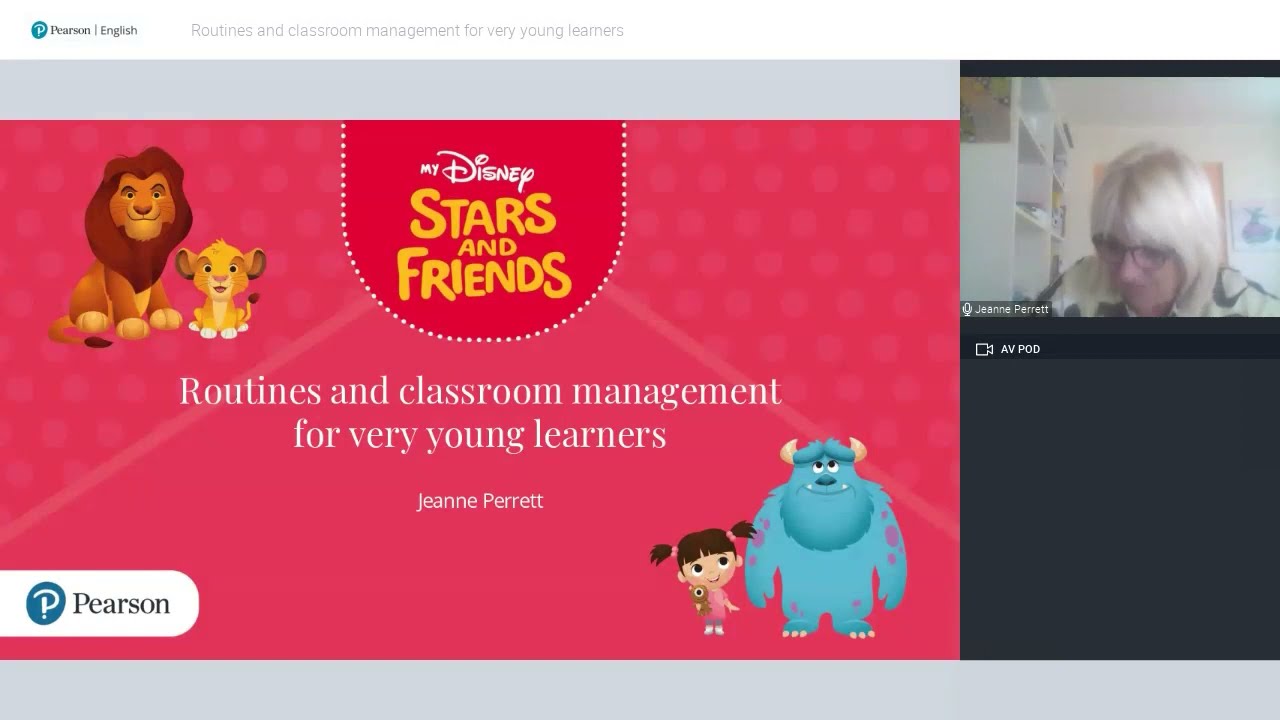
Find more ideas on effective classroom management routines in Jeanne Perrett’s webinar, where she focuses on practical ideas and teaching tips for how we can organise and manage a class of young learners.


Routines and classroom management for very young learners I Pearson English Disney Day
Play
Privacy and cookies

By watching, you agree Pearson can share your viewership data for marketing and analytics for one year, revocable by deleting your cookies.

Want to learn more about teaching young learners? Read our post 'Young learners of English deserve more'.

More blogs from Pearson

  • Children in a classroom with a teacher while they play with a toyhouse
    The importance of teaching values to young learners
    By Katharine Scott
    Reading time: 3 minutes

    Why teaching values matters in early education

    The years children spend in school are about far more than academic success. Alongside literacy, numeracy and subject knowledge, children develop the social and emotional skills needed to thrive in the world around them.

    From sharing ideas to resolving disagreements, these everyday interactions shape how children understand fairness, respect and responsibility. These are more than just learned skills – they are rooted in deeper values that guide behavior over time.

    Without clear guidance, children often learn behaviors simply by observing others. While this can be positive, it can also reinforce negative habits. That’s why schools play a critical role in explicitly teaching values, not just expecting them.

    Social skills vs. Social values

    Although closely related, social skills and values are not the same:

    • Social skills are behaviors (such as taking turns, listening, cooperating)
    • Social values are the principles behind those behaviors (such as fairness, respect, empathy)

    When children understand why something matters—not just what to do—they are more likely to apply those behaviors consistently.

    Core values every child should learn

    Defining values can be complex, but most education systems emphasize a shared set of foundational principles:

    • Respect for others and appreciation of diversity
    • Collaboration and community awareness
    • Environmental responsibility
    • Self-worth and confidence

    Even at a young age, children demonstrate a natural sense of fairness and honesty. With the right support, these instincts can be developed into strong moral foundations.

    Moving beyond “School Rules”

    Too often, values are reduced to simple instructions like:

    • “Don’t be late”
    • “Wait your turn”
    • “Be kind”

    While important, these rules can feel arbitrary if not explained. Without context, children may follow them only when supervised – or break them when they can.

    To truly teach values, educators need to:

    • Explain the reasoning behind rules
    • Encourage discussion and reflection
    • Connect actions to real-world impact

    This transforms rules into meaningful learning experiences.

    Effective school strategies for teaching values

    The most successful approaches to values education involve the entire school community – teachers, students, parents and staff.

    1. Environmental awareness programs

    Schools can foster responsibility through hands-on initiatives such as:

    • Recycling systems
    • School gardens
    • Renewable energy projects
    • Second-hand bookshops

    These activities help children understand their role in protecting the planet.

    2. Anti-bullying initiatives

    Strong anti-bullying programs go beyond policies and focus on prevention through:

    • Empathy-building exercises
    • Peer accountability activities
    • Confidence and self-esteem development

    Helping children recognize and respond to bullying is key to creating a safe environment.

    3. Anti-racism and inclusion programs

    Promoting inclusivity requires a proactive, school-wide approach:

    • Teaching diverse histories and cultures
    • Inviting guest speakers from different communities
    • Challenging stereotypes through discussion
    • Encouraging empathy for marginalized groups

    These efforts help children develop respect for diversity from an early age.

    The role of consistency

    Children learn as much from what adults do as from what they say. For values education to be effective:

    • Teachers must model positive behavior
    • School policies should reflect stated values
    • Parents should be involved where possible

    Consistency across all environments reinforces learning and builds trust.

    Putting values into practice

    Teaching values to young learners is not an “extra” part of education – it is foundational. When children understand respect, empathy and responsibility, they are better equipped to succeed academically, socially and emotionally.

    By embedding values into everyday learning and school culture, educators can help shape thoughtful, responsible individuals who contribute positively to society.

  • A woman and man working together on laptop in library
    AI in Language Education: What educators should use (and what to avoid)
    By Charlotte Guest
    Reading time: 5 minutes

    AI is changing language classrooms fast, but not every tool adds value. The best teachers use AI as a partner, supporting planning, feedback and differentiation, while keeping key moments of teaching human.

    Here’s what works, what to avoid, and how to use AI responsibly in ESL classrooms.

    How AI is transforming language teaching

    AI is transforming how teachers work, but it doesn't replace them.

    At its best, AI enhances three core areas:

    • Planning efficiency: Generate lesson outlines, activities and scaffolding in minutes
    • Differentiation at scale: Adapt materials for mixed-level classrooms instantly
    • Feedback loops: Provide faster, more frequent feedback on writing and practice tasks

    But the key shift is pedagogical. AI aligns naturally with:

    • Learner-centered methods: Students engage more actively with adaptive content
    • Teaching like a coach: Teachers guide, refine and personalize rather than deliver everything directly
    • Modern teaching methodology: Blended, flexible and responsive instruction

    When used effectively, AI allows teachers to concentrate on the most important aspects of language learning: interaction, communication and human connection.

  • A woman smiling working on a laptop
    Studying in the USA? A fast at-home English test is now an option
    By Abi Fordham
    Reading time: 2 minutes

    If you’re a student planning to study in the USA, life probably feels a bit like having too many tabs open at once. University sites. Visa info. Messages from friends already abroad. And a growing list of things that all feel important.

    Somewhere in the middle of that is your English test.

    A test people trust for good reason

    For years, students have chosen PTE because it’s built to be trusted, backed by real expertise, research and quality. That’s why it’s become a familiar name for students planning to study abroad, and why institutions trust it too. That foundation hasn’t changed. What has changed is how students live, learn, and prepare today.

    Same roots, for different routes

    PTE Express originates from the same principles. Same values. Same attention. It’s simply tailored for a different kind of test taker at a specific point in their journey. If you’re aiming to study in the USA and need a quick, at-home English test, PTE Express is made to fit into your life rather than forcing you to reshape everything around a test date. And let’s address test anxiety because it’s a real concern.

    Many students worry about English tests. Not because they don’t know English, but because test situations can make things feel harder than they should be. Speaking to an examiner face‑to‑face can feel intimidating. Worrying about being misunderstood because of your accent is a real concern. Travelling to a test centre adds pressure before you even start. Sitting in an unfamiliar room can make nerves worse.

    That’s not a lack of ability. That’s just being human. While PTE Academic already addresses lots of these worries, we have gone a step further with PTE Express.

    Why at‑home testing can feel different

    One of the quiet benefits of an at‑home test is how much calmer it can feel. You’re in a familiar space. You control your environment. There’s no examiner in front of you, just you and the screen. For many students, that makes it easier to focus and show their real English, without the extra stress that comes from unfamiliar settings or face‑to‑face pressure. PTE Express was designed with this in mind: calm, considered, and supportive, while still being secure and trusted by institutions.

    When the USA is the plan

    If you already know the USA is your destination, things can start to feel more time‑sensitive. Deadlines get closer. Decisions feel heavier. You’re no longer exploring, you’re preparing your next move. PTE Express fits naturally here. It’s a fast, at‑home option for US study, built on the foundations of Pearson that students already trust, and delivered in a way that works for when life is busy and timelines are tight.

    A choice that actually reduces pressure

    The good news is, you don’t have to overthink this. If you want to keep your options open across different countries, there’s a trusted path in PTE Academic that supports that. If you’re focused on studying in the USA and want something fast, familiar and at home, there’s now an option designed for exactly that. No trade‑offs. No feeling like you’re cutting corners. Just choices that match different moments.

    Focus on what really matters

    Studying in the USA is a big step. It’s about independence, growth and starting something new. Your English test should feel like something that supports you quietly in the background, not something that adds more stress to an already intense moment. With PTE Express now live in most countries, including India, students heading to the USA have a calm, trusted at‑home option, built on foundations that have been relied on for years. And sometimes, feeling calm and confident is exactly what helps you do your best.