Grammar 101: insider tips and tricks to instantly improve your writing (part 2)

Hannah Lawrence
Hannah Lawrence
A professional man sits at a desk, writing notes with a laptop open in front of him.
Reading time: 5 minutes

As a proofreader and editor, I'm often asked to explain the rules of grammar. I answered three of the most common questions in the first post of this series, and now it's time to look at another frequent query: how to use apostrophes. Where do they go? When are they needed? And when should they be left out entirely?

Apostrophes might be small but they can cause big confusion because they are used both to indicate posession and to contract words. But the good news is that there are clear, simple patterns to follow, which we'll explore, along with exceptions to watch out for. Whether you’re writing a report or just a text message, these tips will help you use apostrophes correctly and confidently.

Apostrophes with ease: posession

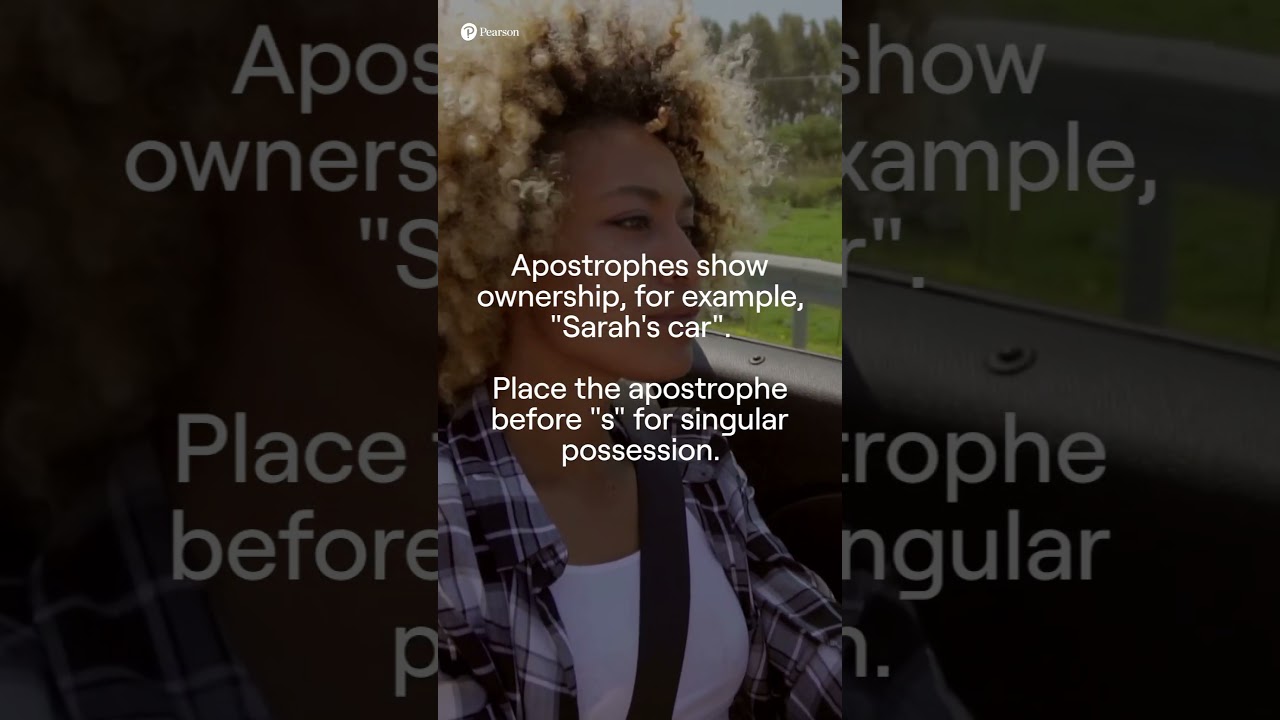
Apostrophes show possession: they tell us something belongs to someone or something. When we want to show possession for regular plurals (when a word needs an "s" to make it plural), the apostrophe goes at the end and no further "s" is added: 

  • The teachers' association
  • The campaigners' letter
  • The dogs' dinner

Whereas, when we want to show posession for either a single noun or an irregular plural (for example, children, geese), we add an "apostrophe s":

  • Sarah's car
  • Pearson's assessment tools
  • The children's presents
  • The geese's pond

Single names that end in an “s” get an “apostrophe s” but plural names get only an apostrophe:

  • Mrs Jones’s car
  • James's cat
  • Whole Foods’ offices
  • Starbucks' nearest store

There's one exception that's important to note: "its" and "it's". The posessive form "its" does not have an apostrophe: "it's" always means "it is". 

  • The cat ate its food

Apostrophes with ease: contractions

Contracted words are the combined and shortened forms of two words, which are commonly used in everyday writing and speech to sound more natural and conversational. They're made by omitting certain letters and replacing them with an apostrophe: for example, in "don't", it replaces the missing “o” from not. 

When you miss one or more letters, use an apostrophe:

  • "would not" becomes "wouldn’t"
  • "cannot" becomes "can’t"
  • "we are" becomes "we're"
  • and, as before, "it is" becomes "it's"

When not to use apostrophes

A common mistake is using apostrophes when making words plural or when refering to decades and numbers. For example:

  • The 1980s had the best music (not "The 1980's")
  • Many people retire from working in their 70s (not "their 70's")
  • I bought some apples at the store (not "apple's")
Using apostrophes: simple tips to improve your writing skills
播放
隱私和Cookies

觀看此視頻表示你同意培生可於一年內使用你觀看的數據以作分析及營銷之用。你可以通過清除cookies撤銷設定。

Test your knowledge

Now you know the basic rules of apostrophes, it's time to check your knowledge.

Which sentence is correct?:

  1. The childrens break time has finished
  2. The childrens' break time has finished
  3. The children's break time has finished

It's sentence 3. We want to show posession – break time belongs to the children – and "children" is plural so it gets an "apostrophe s".
Now try these sentences and see if you can figure out which one is right:

  1. When you're walking my dog, its important to remember it's collar.
  2. When you're walking my dog, it's important to remember its collar.
  3. When youre walking my dog, it's important to remember it's collar.

The correct answer is 2. "You're" is a contraction of "you are", "it is important" so we use "it's" and we show that the collar belongs to the dog by using "its". Finally: 

  1. Luis' daughter won't go to sleep. 
  2. Luis's daughter wont go to sleep. 
  3. Luis's daughter won't go to sleep. 

Here, the right answer is 3. "Luis" is a single name, so gets an "apostrophe s", and "will not" is shortened to "won't". 

Hopefully you now feel more confident in using apostrophes in your writing. Look out for the next post in this series, where we’ll explore more common grammar mistakes and how to avoid them.

More blogs from Pearson

  • A woman holding papers walking through a campus smiling
    Waiting for English test results? Get your scores faster
    提交者 Abi Fordham
    Reading time: 3 minutes

    Let’s be honest. One of the hardest parts of taking an English test isn’t the test itself; it’s what happens afterward. That strange limbo where the test is over, but your future still feels on hold. You’re waiting, refreshing your inbox, thinking about every question you answered, and wondering how long it’ll be until you can finally move on with your plans. If that sounds like you, just remember: it’s totally normal. Completely normal.

    Why waiting feels so intense (and why it’s not “impatience”)

    The moment you finish a test, your brain jumps ahead to everything that depends on that score:

    • Can I apply this week?
    • Will I meet the deadline?
    • Do I need to prepare a backup option?
    • When can I tell my family?

    It’s not just curiosity. It’s the need for certainty so you can take the next step. Because studying in the USA involves so many moving parts – applications, forms, accommodation, visa timelines – and every one of them depends on knowing your score.

    Fast results aren’t just a nice bonus; they directly impact how smoothly your study plan goes.

  • A woman at a computer working
    Introducing the PTE Teacher Hub
    提交者 Magda Woodham
    Reading time: 2 minutes

    Your new home for PTE Teaching Support

    Teaching PTE requires staying up to date, being confident in your scoring and being equipped with resources that accurately reflect the test – so you can help your students prepare for success and ease some of their test-day worries. To make that easier, we’re pleased to introduce you to the new PTE Teacher Hub, your dedicated space designed specifically for teachers preparing learners for PTE Academic and PTE Core.

    Everything you need to teach PTE, in one trusted place

    The PTE Teacher Hub is an authenticated, teacher‑first platform that brings together everything you need to teach PTE effectively. Instead of searching across multiple channels, you now have a single, reliable source for official updates, classroom‑ready resources and professional development – direct from Pearson.

    Official updates and ready‑to‑use resources, all in one hub

    At launch, the Hub focuses on the two core areas that teachers told us matter most. PTE News and Updates provides a trusted channel for timely information on Pearson news, PTE updates, information on upcoming webinars and events, assessment insights and community highlights, helping you stay confident that the guidance you give learners is accurate and up to date.

    PTE Resources offers an exclusive library of ready‑to‑use, PTE‑aligned lesson plans and materials, saving preparation time and supporting both in‑class and online teaching.

    Built to support teachers at every stage of their PTE journey

    Beyond day‑to‑day teaching support, the PTE Teacher Hub is designed to support your ongoing professional growth. Teachers can access guidance and insights at any time, deepen their understanding of the PTE test portfolio and strengthen their teaching practice with official Pearson materials.

    Whether you’re new to teaching PTE or an experienced educator, the PTE Teacher Hub is your central destination for clarity, confidence and connection.

    Log in, bookmark the page, and make it your go‑to home for PTE teaching.

  • Children in a classroom with a teacher while they play with a toyhouse
    The importance of teaching values to young learners
    提交者 Katharine Scott
    Reading time: 3 minutes

    Why teaching values matters in early education

    The years children spend in school are about far more than academic success. Alongside literacy, numeracy and subject knowledge, children develop the social and emotional skills needed to thrive in the world around them.

    From sharing ideas to resolving disagreements, these everyday interactions shape how children understand fairness, respect and responsibility. These are more than just learned skills – they are rooted in deeper values that guide behavior over time.

    Without clear guidance, children often learn behaviors simply by observing others. While this can be positive, it can also reinforce negative habits. That’s why schools play a critical role in explicitly teaching values, not just expecting them.

    Social skills vs. Social values

    Although closely related, social skills and values are not the same:

    • Social skills are behaviors (such as taking turns, listening, cooperating)
    • Social values are the principles behind those behaviors (such as fairness, respect, empathy)

    When children understand why something matters—not just what to do—they are more likely to apply those behaviors consistently.

    Core values every child should learn

    Defining values can be complex, but most education systems emphasize a shared set of foundational principles:

    • Respect for others and appreciation of diversity
    • Collaboration and community awareness
    • Environmental responsibility
    • Self-worth and confidence

    Even at a young age, children demonstrate a natural sense of fairness and honesty. With the right support, these instincts can be developed into strong moral foundations.

    Moving beyond “School Rules”

    Too often, values are reduced to simple instructions like:

    • “Don’t be late”
    • “Wait your turn”
    • “Be kind”

    While important, these rules can feel arbitrary if not explained. Without context, children may follow them only when supervised – or break them when they can.

    To truly teach values, educators need to:

    • Explain the reasoning behind rules
    • Encourage discussion and reflection
    • Connect actions to real-world impact

    This transforms rules into meaningful learning experiences.

    Effective school strategies for teaching values

    The most successful approaches to values education involve the entire school community – teachers, students, parents and staff.

    1. Environmental awareness programs

    Schools can foster responsibility through hands-on initiatives such as:

    • Recycling systems
    • School gardens
    • Renewable energy projects
    • Second-hand bookshops

    These activities help children understand their role in protecting the planet.

    2. Anti-bullying initiatives

    Strong anti-bullying programs go beyond policies and focus on prevention through:

    • Empathy-building exercises
    • Peer accountability activities
    • Confidence and self-esteem development

    Helping children recognize and respond to bullying is key to creating a safe environment.

    3. Anti-racism and inclusion programs

    Promoting inclusivity requires a proactive, school-wide approach:

    • Teaching diverse histories and cultures
    • Inviting guest speakers from different communities
    • Challenging stereotypes through discussion
    • Encouraging empathy for marginalized groups

    These efforts help children develop respect for diversity from an early age.

    The role of consistency

    Children learn as much from what adults do as from what they say. For values education to be effective:

    • Teachers must model positive behavior
    • School policies should reflect stated values
    • Parents should be involved where possible

    Consistency across all environments reinforces learning and builds trust.

    Putting values into practice

    Teaching values to young learners is not an “extra” part of education – it is foundational. When children understand respect, empathy and responsibility, they are better equipped to succeed academically, socially and emotionally.

    By embedding values into everyday learning and school culture, educators can help shape thoughtful, responsible individuals who contribute positively to society.