Skip to main content
Precalculus
My Course
Learn
Exam Prep
AI Tutor
Study Guides
Flashcards
Explore
My Course
Learn
Exam Prep
AI Tutor
Study Guides
Flashcards
Explore
Back
Graphing Logarithmic Functions definitions
You can tap to flip the card.
Logarithmic Function
You can tap to
flip the card.
👆
Logarithmic Function
Inverse of an exponential function, typically featuring a vertical asymptote and a domain restricted to positive real numbers.
Track progress
Control buttons has been changed to "navigation" mode.
1/15
Related practice
Recommended videos
Guided course
5:26
Graphs of Logarithmic Functions
Patrick
937
views
18
rank
Guided course
4:30
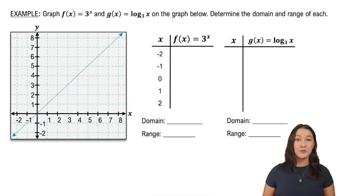
Graphing Logarithmic Functions
Patrick
593
views
15
rank
Guided course
4:37
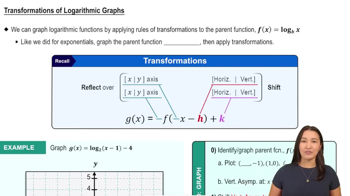
Transformations of Logarithmic Graphs
Patrick
643
views
7
rank
Terms in this set (15)
Hide definitions
Logarithmic Function
Inverse of an exponential function, typically featuring a vertical asymptote and a domain restricted to positive real numbers.
Exponential Function
Function where the variable is in the exponent, serving as the inverse of a logarithmic function.
Inverse Function
A function that reverses the effect of another, such that their graphs are reflections over the line y = x.
Vertical Asymptote
A dashed line on a graph, often at x = 0 for logarithmic functions, which the curve approaches but never touches.
Horizontal Asymptote
A dashed line, often at y = 0 for exponential functions, that the graph approaches as x increases or decreases.
Parent Function
The simplest form of a function in a family, used as the starting point for transformations.
Transformation
An operation such as shifting, reflecting, or stretching that alters the position or shape of a graph.
Reflection
A transformation producing a mirror image of a graph over a specific axis, determined by the sign of coefficients.
Horizontal Shift
A transformation moving the graph left or right, determined by the value added or subtracted inside the function.
Vertical Shift
A transformation moving the graph up or down, determined by the value added or subtracted outside the function.
Domain
The set of all possible input values for a function, for logarithmic functions typically restricted by the asymptote.
Range
The set of all possible output values for a function, for logarithmic functions it is all real numbers.
Base
The constant in a logarithmic or exponential function that determines the rate of growth or decay.
Ordered Pair
A pair of numbers (x, y) representing a point on the graph, often found by plugging values into the function.
Test Point
A specific point calculated and plotted to help sketch the graph of a function, especially after transformations.
 Back
Back
 Back
Back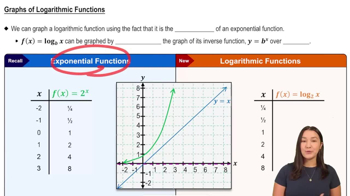
 5:26
5:26