Skip to main content
Analytical Chemistry
My Course
Learn
Exam Prep
AI Tutor
Study Guides
Flashcards
Explore
Try the app
My Course
Learn
Exam Prep
AI Tutor
Study Guides
Flashcards
Explore
Try the app
Back
Analyte Oxidation State definitions
You can tap to flip the card.
Oxidation State
You can tap to flip the card.
👆
Oxidation State
A numerical value representing the charge an atom would have if all bonds were ionic, crucial for redox analysis.
Track progress
Control buttons has been changed to "navigation" mode.
1/15
Related flashcards
Related practice
Recommended videos
Analyte Oxidation State quiz
Analyte Oxidation State
15 Terms
Analyte Oxidation State
15. Redox Titrations
5 problems
Topic
Oxidizing Agents
15. Redox Titrations
5 problems
Topic
15. Redox Titrations
4 topics
12 problems
Chapter
Guided course
05:08
Analyte Oxidation State
338
views
2
rank
Guided course
05:01
Analyte Oxidation State
283
views
1
rank
Guided course
06:03
Analyte Oxidation State Calculations
241
views
Terms in this set (15)
Hide definitions
Oxidation State
A numerical value representing the charge an atom would have if all bonds were ionic, crucial for redox analysis.
Redox Titration
A quantitative analysis method where electron transfer reactions determine analyte concentration.
Analyte
The substance in a chemical analysis whose composition or concentration is being measured.
Oxidizing Agent
A chemical species that accepts electrons, causing another species to increase its oxidation state.
Reducing Agent
A substance that donates electrons, causing another species to decrease its oxidation state.
Cerium(IV) Ion
A powerful oxidizer, often used to convert iron(II) to iron(III) by accepting electrons.
Peroxydisulfate
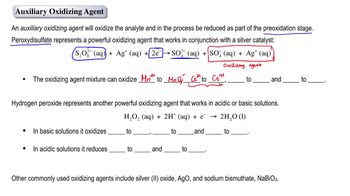
A strong oxidizer, especially effective with a silver catalyst, capable of oxidizing even cerium(III).
Jones Reductor
A reduction column filled with zinc amalgam, used to reduce analytes to a single oxidation state.
Walden Reductor
A reduction column containing silver granules, used to reduce analytes in acidified solutions.
Hydrogen Peroxide
A versatile reagent acting as either an oxidizer or reducer, depending on the solution's acidity or basicity.
Auxiliary Reducing Agent
A metal or compound used to ensure the analyte is fully reduced to a single oxidation state before titration.
Auxiliary Oxidizing Agent
A reagent used to convert all analyte species to a higher oxidation state, ensuring uniformity for titration.
Reduction Column
A device packed with a reducing metal, facilitating the conversion of analytes to a single oxidation state.
Pre-oxidation Stage
A preparatory step where analytes are oxidized to a uniform state before quantitative analysis.
Pre-reduction Step
A preparatory process where analytes are reduced to a single oxidation state prior to titration.
 BackBack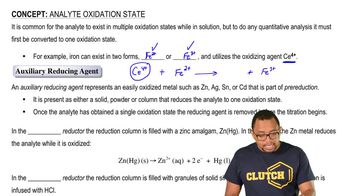
 05:08
05:08