Skip to main content
Analytical Chemistry
My Course
Learn
Exam Prep
AI Tutor
Study Guides
Flashcards
Explore
Try the app
My Course
Learn
Exam Prep
AI Tutor
Study Guides
Flashcards
Explore
Try the app
Back
Buffers definitions
You can tap to flip the card.
Buffer
You can tap to flip the card.
👆
Buffer
A solution containing a weak acid and its conjugate base that resists significant pH changes when strong acids or bases are added.
Track progress
Control buttons has been changed to "navigation" mode.
1/15
Related flashcards
Related practice
Recommended videos
Buffers quiz
Buffers
15 Terms
Buffers
8. Monoprotic Acid-Base Equilibria
5 problems
Topic
Ionic Salts of Weak Acids and Bases
8. Monoprotic Acid-Base Equilibria
5 problems
Topic
8. Monoprotic Acid-Base Equilibria - Part 1 of 2
4 topics
12 problems
Chapter
8. Monoprotic Acid-Base Equilibria - Part 2 of 2
4 topics
12 problems
Chapter
Guided course
03:29
Buffer Synthesis Calculations 2
297
views
3
rank
Guided course
03:53
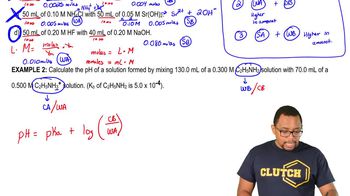
Buffer Synthesis Calculations 1
331
views
4
rank
1
comments
Guided course
01:44
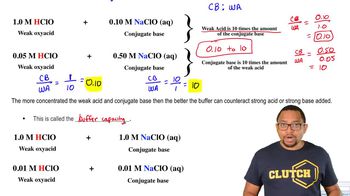
Buffers
412
views
5
rank
Terms in this set (15)
Hide definitions
Buffer
A solution containing a weak acid and its conjugate base that resists significant pH changes when strong acids or bases are added.
Weak Acid
A substance that partially dissociates in water, providing limited hydrogen ions and forming the basis of many buffer systems.
Conjugate Base
The species formed when a weak acid loses a hydrogen ion, often paired with a metal ion in buffer solutions.
pH
A logarithmic measure of hydrogen ion concentration, indicating the acidity or basicity of a solution.
Buffer Capacity
The extent to which a buffer can neutralize added strong acids or bases before a significant pH change occurs.
Buffer Range
The ratio window (0.1 to 10) of conjugate base to weak acid concentrations where a buffer effectively resists pH changes.
Henderson-Hasselbalch Equation
A formula used to calculate the pH of a buffer solution using the pKa and the ratio of conjugate base to weak acid.
Monoprotic Acid
An acid capable of donating only one proton per molecule, simplifying buffer calculations to a single pKa value.
Neutralization Reaction
A process where an acid and a base react to form water and a salt, central to buffer action against strong acids or bases.
Ideal Buffer
A buffer system where the concentrations of weak acid and conjugate base are equal, maximizing resistance to pH changes.
Molarity
A concentration unit expressing the number of moles of solute per liter of solution, commonly used in buffer calculations.
Polyprotic Acid
A substance capable of donating more than one proton per molecule, requiring multiple pKa values for buffer calculations.
pKa
The negative logarithm of the acid dissociation constant, indicating the strength of a weak acid in buffer systems.
Strong Acid
A substance that completely dissociates in water, often used to test or create buffer systems when mixed with a weak base.
Strong Base
A compound that fully dissociates in water, reacting with weak acids to form buffer solutions under specific conditions.
 BackBack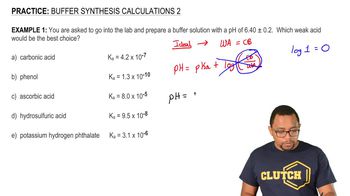
 03:29
03:29