Skip to main content
Analytical Chemistry
My Course
Learn
Exam Prep
AI Tutor
Study Guides
Flashcards
Explore
Try the app
My Course
Learn
Exam Prep
AI Tutor
Study Guides
Flashcards
Explore
Try the app
Back
Buffers quiz
You can tap to flip the card.
What two components make up a buffer solution?
You can tap to flip the card.
👆
What two components make up a buffer solution?
A buffer is made up of a weak acid and its conjugate base.
Track progress
Control buttons has been changed to "navigation" mode.
1/15
Related flashcards
Related practice
Recommended videos
Buffers definitions
Buffers
15 Terms
Buffers
8. Monoprotic Acid-Base Equilibria
5 problems
Topic
Ionic Salts of Weak Acids and Bases
8. Monoprotic Acid-Base Equilibria
5 problems
Topic
8. Monoprotic Acid-Base Equilibria - Part 1 of 2
4 topics
12 problems
Chapter
8. Monoprotic Acid-Base Equilibria - Part 2 of 2
4 topics
12 problems
Chapter
Guided course
03:29
Buffer Synthesis Calculations 2
297
views
3
rank
Guided course
03:53
Buffer Synthesis Calculations 1
331
views
4
rank
1
comments
Guided course
01:44
Buffers
412
views
5
rank
Terms in this set (15)
Hide definitions
What two components make up a buffer solution?
A buffer is made up of a weak acid and its conjugate base.
How does a buffer resist changes in pH when a strong base is added?
The weak acid in the buffer neutralizes the added strong base, minimizing pH change.
What happens to a buffer when too much strong acid is added?
The conjugate base is consumed, and if all is used up, the buffer can no longer resist pH changes.
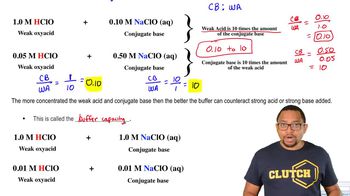
What is the ideal ratio range of conjugate base to weak acid for an effective buffer?
The ratio should be between 0.10 and 10 for the buffer to be effective.
What is buffer capacity and how can it be increased?
Buffer capacity is the ability of a buffer to resist pH changes, and it increases with higher concentrations of the buffer components.
What is the Henderson-Hasselbalch equation for calculating buffer pH?
The equation is pH = pKa + log(conjugate base/weak acid).
When is a buffer considered 'ideal'?
A buffer is ideal when the concentrations of weak acid and conjugate base are equal.
Why does a buffer stop working if too much strong acid or base is added?
Because one component (either weak acid or conjugate base) is completely consumed, so the buffer can no longer neutralize added acid or base.
What is one example of a buffer system in the human body?
The carbonic acid and bicarbonate system acts as a buffer in blood.
What are three ways to create a buffer solution?
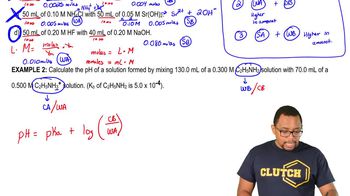
Mix a weak acid with its conjugate base, mix a strong acid with the conjugate base of a weak acid, or mix a strong base with a weak acid.
In the creation of a buffer by mixing changing strengths, which component must be in excess?
The weak component (either weak acid or conjugate base) must be in higher concentration than the strong component.
What happens if the ratio of conjugate base to weak acid is outside the 0.10 to 10 range?
The solution will not function effectively as a buffer.
Can the Henderson-Hasselbalch equation be used for polyprotic acids?
It is primarily used for monoprotic acids; polyprotic acids require their own versions of the equation.
What units can be used in the Henderson-Hasselbalch equation for buffer calculations?
Either molarity or moles can be used, depending on the information provided.
Why is a buffer with higher concentrations of its components more effective?
Because it can neutralize larger amounts of added strong acid or base before being depleted.
 BackBack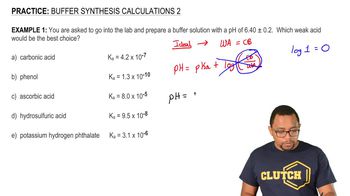
 03:29
03:29