Skip to main content
Analytical Chemistry
My Course
Learn
Exam Prep
AI Tutor
Study Guides
Flashcards
Explore
Try the app
My Course
Learn
Exam Prep
AI Tutor
Study Guides
Flashcards
Explore
Try the app
Back
Diprotic Buffers definitions
You can tap to flip the card.
Diprotic Acid
You can tap to flip the card.
👆
Diprotic Acid
A molecule containing two acidic hydrogens, each capable of dissociating in solution, leading to two distinct ionization steps.
Track progress
Control buttons has been changed to "navigation" mode.
1/15
Related flashcards
Related practice
Recommended videos
Diprotic Buffers quiz
Diprotic Buffers
15 Terms
Diprotic Buffers
9. Polyprotic Acid-Base Equilibria
5 problems
Topic
Polyprotic Buffers
9. Polyprotic Acid-Base Equilibria
5 problems
Topic
9. Polyprotic Acid-Base Equilibria - Part 1 of 2
4 topics
12 problems
Chapter
9. Polyprotic Acid-Base Equilibria - Part 2 of 2
2 topics
6 problems
Chapter
Guided course
02:45
Monoprotic & Diprotic Buffer Calculations 1
379
views
5
rank
Guided course
06:44
Monoprotic & Diprotic Buffer Calculations 1
379
views
3
rank
2
comments
Guided course
01:51
Diprotic Buffers
542
views
5
rank
Terms in this set (15)
Hide definitions
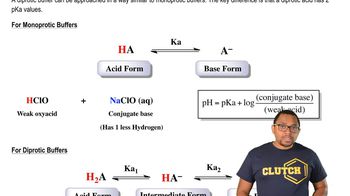
Diprotic Acid
A molecule containing two acidic hydrogens, each capable of dissociating in solution, leading to two distinct ionization steps.
Acidic Hydrogen
A proton within a molecule that can be released during dissociation, contributing to the molecule's acidic properties.
Ka1
The equilibrium constant describing the dissociation of the first acidic hydrogen from a molecule with more than one acidic proton.
Ka2
The equilibrium constant for the removal of the second acidic hydrogen in a molecule with two acidic protons.
pKa1
The negative logarithm of the first dissociation constant, indicating the strength of the initial proton release.
pKa2
The negative logarithm of the second dissociation constant, reflecting the ease of losing the second proton.
Conjugate Base
The species formed when an acid donates a proton, possessing one fewer hydrogen than the original acid.
Intermediate Form
The partially deprotonated species in a diprotic system, having lost only one acidic hydrogen.
Base Form
The fully deprotonated species in a diprotic system, with both acidic hydrogens removed.
Henderson-Hasselbalch Equation
A formula relating pH, pKa, and the ratio of conjugate base to acid, adapted for each dissociation step in diprotic systems.
Buffer System
A solution that resists pH changes by containing a weak acid and its conjugate base, or their equivalents in diprotic cases.
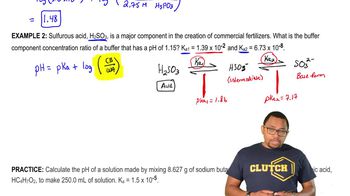
Sulfurous Acid
A diprotic acid, H2SO3, used as an example for illustrating sequential proton loss and buffer calculations.
Hydrogen Sulfite
The intermediate form of sulfurous acid after losing one proton, also known as bisulfite.
Sulfite Ion
The base form of sulfurous acid, resulting from the loss of both acidic hydrogens.
Polyprotic Acid
A molecule containing more than one acidic hydrogen, capable of undergoing multiple dissociation steps.
 BackBack
 02:45
02:45