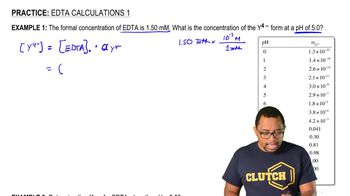
It means EDTA has six acidic hydrogens that can be lost as protons, resulting in different forms depending on the pH.
How does the pH of a solution affect the form of EDTA present?
The pH determines how many protons are removed from EDTA, changing its charge and form from fully protonated to fully deprotonated.
Which groups in EDTA are more acidic: carboxyl or amine groups?
The carboxyl groups are more acidic than the amine groups, so they lose their protons first as pH increases.
How many different forms can EDTA exist in depending on pH?
EDTA can exist in up to 7 different forms depending on the pH of the solution.
What is the charge of fully deprotonated EDTA?
Fully deprotonated EDTA has a charge of -4 (Y4-).
Why is the basic form of EDTA important in metal complex formation?
The basic form (Y4-) is ideal for forming complexes with metal ions because all acidic protons have been removed, allowing it to bind metals effectively.
At what pH does the basic form of EDTA become the predominant species?
The basic form predominates at pH values higher than about 10.37.
How can you calculate the fraction of EDTA in its basic form?
You calculate it by dividing the concentration of the basic form by the total concentration of all EDTA forms, using pH and pKa values.
What does the formation or stability constant (KF) represent in EDTA chemistry?
KF represents the equilibrium constant for the reaction between EDTA and a metal ion to form a complex.
How does the charge of a metal ion affect its complex formation with EDTA?
Metals with higher positive charges form stronger complexes with EDTA, resulting in higher KF values.
What is the conditional formation constant (KF') and why is it used?
KF' adjusts the formation constant for the actual pH, accounting for the fraction of EDTA in its basic form, and is used to calculate free metal ion concentration at any pH.
How is the overall charge of an EDTA-metal complex determined?
It is the sum of the metal ion's charge and the charge of EDTA (usually -4 in its basic form).
Why is the neutral form of EDTA useful for storage and transport?
The neutral form is easiest to keep intact in solution, making it ideal for storage and transport.
What happens to the fraction of EDTA in its basic form as pH decreases?
As pH decreases, less EDTA exists in the basic form and more exists in other protonated forms.
What is the relationship between pH, pKa, and protonation state in EDTA?
If pH > pKa, deprotonation occurs; if pH < pKa, the group remains protonated.
 Back
Back
 05:31
05:31