Skip to main content
Analytical Chemistry
My Course
Learn
Exam Prep
AI Tutor
Study Guides
Flashcards
Explore
Try the app
My Course
Learn
Exam Prep
AI Tutor
Study Guides
Flashcards
Explore
Try the app
Back
Oxidizing Agents quiz
You can tap to flip the card.
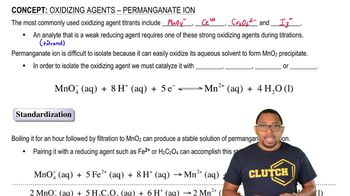
Why is permanganate ion (MnO4-) difficult to maintain as an oxidizing agent in solution?
You can tap to flip the card.
👆
Why is permanganate ion (MnO4-) difficult to maintain as an oxidizing agent in solution?
Permanganate ion tends to form manganese oxide precipitate, especially when exposed to light or impurities, making it hard to keep a pure solution.
Track progress
Control buttons has been changed to "navigation" mode.
1/15
Related flashcards
Related practice
Recommended videos
Oxidizing Agents definitions
Oxidizing Agents
15 Terms
Oxidizing Agents
15. Redox Titrations
5 problems
Topic
Analyte Oxidation State
15. Redox Titrations
5 problems
Topic
15. Redox Titrations
4 topics
12 problems
Chapter
Guided course
03:15
Oxidizing Agent - Dichromate Ion
275
views
Guided course
05:25
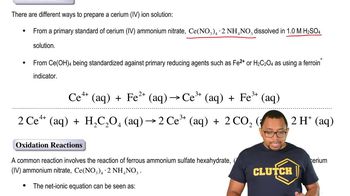
Oxidizing Agent - Cerium (IV) Ion
394
views
1
rank
Guided course
04:26
Oxidizing Agent - Permanganate Ion
288
views
1
rank
Terms in this set (15)
Hide definitions
Why is permanganate ion (MnO4-) difficult to maintain as an oxidizing agent in solution?
Permanganate ion tends to form manganese oxide precipitate, especially when exposed to light or impurities, making it hard to keep a pure solution.
What color change indicates the endpoint in a permanganate titration in acidic solution?
A slight pink color appears, indicating excess permanganate ion and the endpoint of the titration.
Why can't permanganate ion be used as a primary standard?
It is difficult to maintain a pure solution due to the constant formation of manganese oxide precipitate.
What is the main advantage of dichromate ion over permanganate and cerium(IV) ions as an oxidizing agent?
Dichromate ion is more stable and can be used as a primary standard, making it easier to store and use.
Why can't dichromate ion be used as its own indicator in titrations?
The color difference between dichromate (orange) and its reduced form chromium(III) (green) is not distinct enough to serve as an indicator.
What indicator is commonly used with dichromate ion in titrations?
Diphenylaminesulfonic acid or Diphenylbenzadinesulfonic acid is used, which changes from colorless to red-violet upon oxidation.
What is the main reason cerium(IV) ion is less commonly used as an oxidizing agent?
Its preparation and storage are costly and time-consuming compared to other oxidizing agents.
What makes cerium(IV) ion a strong oxidizing agent?
Cerium(IV) ion strongly desires to be reduced to the more stable cerium(III) ion, driving oxidation of analytes.
How is triiodide ion (I3-) typically standardized?
It is standardized using sodium thiosulfate (Na2S2O3) with starch as the indicator.
What color does starch turn in the presence of triiodide ion?
Starch turns black when it reacts with triiodide ion.
Which oxidizing agent is the weakest among permanganate, cerium(IV), dichromate, and triiodide ions?
Triiodide ion (I3-) is the weakest oxidizing agent among the four.
What happens to primary alcohols when oxidized by dichromate ion?
Primary alcohols are first oxidized to aldehydes and, under stronger conditions, further oxidized to carboxylic acids.
Why can't tertiary alcohols be oxidized by dichromate ion?
Oxidizing tertiary alcohols would require breaking a carbon-carbon bond, which is energetically unfavorable.
What is the main use of permanganate and cerium(IV) ions in redox titrations?
They are used to oxidize weak reducing agents due to their strong oxidizing power.
What factors influence the choice of oxidizing agent in analytical applications?
Strength, stability, cost, and the specific requirements of the reaction or titration process determine the choice.
 BackBack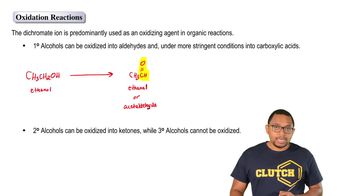
 03:15
03:15