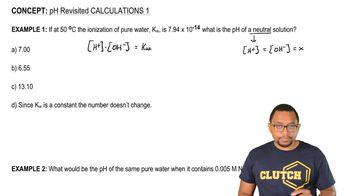
What is the formula for calculating pH from the concentration of H+ ions?
pH = -log[H+], where [H+] is the concentration of hydrogen ions.
At 50°C, if the Kw of water is 7.94 x 10^-14, what is the concentration of H+ in pure water?
The concentration of H+ is the square root of Kw, which is 2.82 x 10^-7 M.
Why does the value of Kw change with temperature?
Kw is temperature dependent because the ionization of water increases with temperature, altering the equilibrium constant.
What is the pH of pure water at 50°C when Kw = 7.94 x 10^-14?
The pH is 6.55, calculated as -log(2.82 x 10^-7).
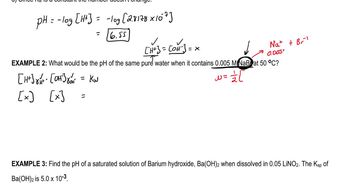
How do free floating ions like Na+ and Br- affect the pH calculation in water?
They increase the ionic strength, which affects the activity coefficients and slightly alters the effective concentration of H+ used in the pH calculation.
What is the role of the activity coefficient in pH calculations?
The activity coefficient adjusts the effective concentration of ions to account for non-ideal behavior due to ionic strength.
How is ionic strength calculated for a solution containing Na+ and Br-?
Ionic strength is calculated as 0.5 × (concentration of Na+ × charge^2 + concentration of Br- × charge^2).
What is the effect on pH when the activity coefficient of H+ is less than 1?
The effective concentration of H+ decreases, resulting in a slightly lower pH than if the activity coefficient were 1.
What is the pH of pure water with Na+ and Br- ions present at 50°C?
The pH is 6.54, slightly lower than pure water due to the effect of ionic strength and activity coefficients.
How does the presence of non-common ions like lithium nitrate affect the solubility of barium hydroxide?
Non-common ions increase the ionic strength, which increases the solubility of barium hydroxide by affecting activity coefficients.
What is the Ksp expression for barium hydroxide dissolving in water?
Ksp = [Ba^2+][OH^-]^2, but in the presence of ionic strength, it includes activity coefficients: Ksp = [Ba^2+](γ_Ba^2+)[OH^-]^2(γ_OH^-)^2.
How do you find the concentration of OH- in a saturated solution of Ba(OH)2 with non-common ions present?
First, solve for x using the Ksp expression with activity coefficients, then multiply x by 2 to get [OH^-].
How is the activity of OH- calculated in these solutions?
The activity of OH- is the product of its concentration and its activity coefficient.
How do you calculate pOH from the activity of OH-?
pOH = -log(activity of OH-), where activity is concentration times activity coefficient.
What is the final pH of a saturated Ba(OH)2 solution in 0.05 M lithium nitrate?
The pH is approximately 13.41, accounting for increased solubility and activity coefficients due to ionic strength.
 Back
Back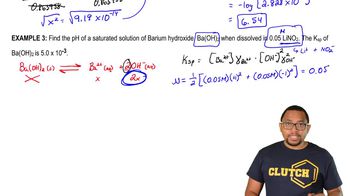
 06:13
06:13