Skip to main content
Analytical Chemistry
My Course
Learn
Exam Prep
AI Tutor
Study Guides
Flashcards
Explore
Try the app
My Course
Learn
Exam Prep
AI Tutor
Study Guides
Flashcards
Explore
Try the app
Back
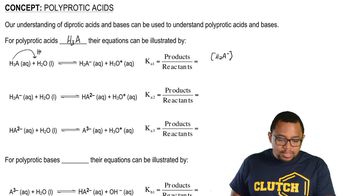
Polyprotic Acids and Bases definitions
You can tap to flip the card.
Polyprotic Acid
You can tap to flip the card.
👆
Polyprotic Acid
A molecule capable of donating more than one proton in sequential steps, each with its own equilibrium constant.
Track progress
Control buttons has been changed to "navigation" mode.
1/14
Related flashcards
Related practice
Recommended videos
Polyprotic Acids and Bases quiz
Polyprotic Acids and Bases
15 Terms
Polyprotic Acids and Bases
9. Polyprotic Acid-Base Equilibria
5 problems
Topic
Diprotic Buffers
9. Polyprotic Acid-Base Equilibria
5 problems
Topic
9. Polyprotic Acid-Base Equilibria - Part 1 of 2
4 topics
12 problems
Chapter
9. Polyprotic Acid-Base Equilibria - Part 2 of 2
2 topics
6 problems
Chapter
Guided course
02:20
Polyprotic Bases
529
views
4
rank
Guided course
02:30
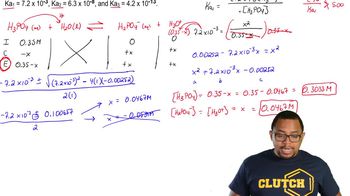
Polyprotic Acids
553
views
6
rank
Guided course
15:57
Polyprotic Acid Calculations
434
views
3
rank
2
comments
Terms in this set (14)
Hide definitions
Polyprotic Acid
A molecule capable of donating more than one proton in sequential steps, each with its own equilibrium constant.
Polyprotic Base
A species able to accept multiple protons in stages, each governed by a distinct equilibrium constant.
Ka1
The equilibrium constant for the removal of the first acidic hydrogen from a fully protonated acid.
Ka2
The equilibrium constant describing the loss of the second proton from an intermediate acid form.
Ka3
The equilibrium constant for the removal of the third proton in a triprotic acid system.
Kb1
The equilibrium constant for the first proton addition to a fully deprotonated base form.
Kb2
The equilibrium constant for the second proton addition to an intermediate base form.
Kb3
The equilibrium constant for the third proton addition in a polyprotic base.
Kw
The ion-product constant for water, linking acid and base equilibria in polyprotic systems.
Intermediate Form
A species formed after losing or gaining one or more, but not all, protons in a polyprotic system.
Fully Protonated Form
The state where all possible acidic hydrogens remain attached to the molecule.
Fully Deprotonated Form
The state where all acidic hydrogens have been removed, leaving the species as a base.
ICE Chart
A tabular method for tracking initial, change, and equilibrium concentrations in acid-base calculations.
Formal Concentration
The initial total concentration of a species before any reaction or equilibrium shift occurs.
 BackBack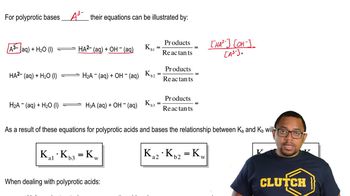
 02:20
02:20