Skip to main content
Analytical Chemistry
My Course
Learn
Exam Prep
AI Tutor
Study Guides
Flashcards
Explore
Try the app
My Course
Learn
Exam Prep
AI Tutor
Study Guides
Flashcards
Explore
Try the app
Back
Polyprotic Buffers quiz
You can tap to flip the card.
What is typically meant by a polyprotic buffer in analytical chemistry?
You can tap to flip the card.
👆
What is typically meant by a polyprotic buffer in analytical chemistry?
A polyprotic buffer usually refers to a triprotic buffer, which contains an acid with three acidic hydrogens.
Track progress
Control buttons has been changed to "navigation" mode.
1/15
Related flashcards
Related practice
Recommended videos
Polyprotic Buffers definitions
Polyprotic Buffers
14 Terms
Polyprotic Buffers
9. Polyprotic Acid-Base Equilibria
5 problems
Topic
Principal Species
9. Polyprotic Acid-Base Equilibria
5 problems
Topic
9. Polyprotic Acid-Base Equilibria - Part 1 of 2
4 topics
12 problems
Chapter
9. Polyprotic Acid-Base Equilibria - Part 2 of 2
2 topics
6 problems
Chapter
Guided course
06:42
Polyprotic Buffers
636
views
1
rank
1
comments
Terms in this set (15)
Hide definitions
What is typically meant by a polyprotic buffer in analytical chemistry?
A polyprotic buffer usually refers to a triprotic buffer, which contains an acid with three acidic hydrogens.
How many Ka values does a triprotic acid have?
A triprotic acid has three Ka values, one for each acidic hydrogen that can be removed.
What is the fully protonated form of a triprotic acid commonly represented as?
The fully protonated form is represented as H3A.
What is the first intermediate species formed after removing one hydrogen from a triprotic acid?
The first intermediate is H2A⁻, formed after removing the first acidic hydrogen.
Which Ka value is used when relating the fully protonated form and the first intermediate in the Henderson-Hasselbalch equation?
Ka1 is used when relating H3A and H2A⁻ in the Henderson-Hasselbalch equation.
In the Henderson-Hasselbalch equation for polyprotic buffers, which form goes in the numerator?
The more basic form, which has one less acidic hydrogen, goes in the numerator.
What is the second intermediate species in the dissociation of a triprotic acid?
The second intermediate is HA²⁻, formed after removing the second acidic hydrogen.
Which Ka value is used when relating the first and second intermediate forms in a triprotic buffer?
Ka2 is used when relating H2A⁻ and HA²⁻.
What is the fully deprotonated form of a triprotic acid?
The fully deprotonated form is A³⁻.
When using the Henderson-Hasselbalch equation, what can be used in place of molarity for the ratio?
Moles can be used in place of molarity for the ratio in the Henderson-Hasselbalch equation.
Why is it important to know which forms of a polyprotic acid are present when calculating pH?
It determines which Ka value and which form of the Henderson-Hasselbalch equation to use.
What is the general formula for calculating moles from volume and molarity?
Moles = liters × molarity.
In a buffer calculation, if you have 0.10 M citric acid and 0.15 M of its first intermediate, which Ka do you use?
You use Ka1 because you are relating the acid form and the first intermediate.
What is the pH if you have 0.25 moles of the more basic form and 0.10 moles of the more acidic form, using Ka2 = 1.7 × 10⁻⁵?
The pH is calculated as pH = -log(1.7 × 10⁻⁵) + log(0.25/0.10), which gives 4.94.
What should you always check before applying the Henderson-Hasselbalch equation to a polyprotic buffer?
You should check which forms of the acid are present to select the correct Ka value.
 BackBack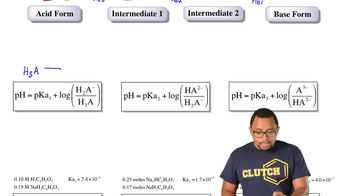
 06:42
06:42