Skip to main content
Analytical Chemistry
My Course
Learn
Exam Prep
AI Tutor
Study Guides
Flashcards
Explore
Try the app
My Course
Learn
Exam Prep
AI Tutor
Study Guides
Flashcards
Explore
Try the app
Back
Polyprotic Titrations definitions
You can tap to flip the card.
Polyprotic Acid
You can tap to flip the card.
👆
Polyprotic Acid
A substance capable of donating more than one proton, leading to multiple equivalence points during titration.
Track progress
Control buttons has been changed to "navigation" mode.
1/15
Related flashcards
Related practice
Recommended videos
Polyprotic Titrations quiz
Polyprotic Titrations
15 Terms
Polyprotic Titrations
10. Acid-Base Titrations
5 problems
Topic
Diprotic Acid Titrations
10. Acid-Base Titrations
5 problems
Topic
10. Acid-Base Titrations - Part 1 of 2
4 topics
12 problems
Chapter
10. Acid-Base Titrations - Part 2 of 2
1 topic
3 problems
Chapter
Guided course
01:50
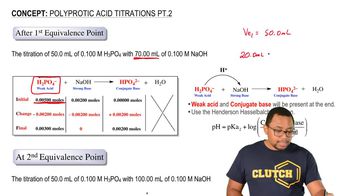
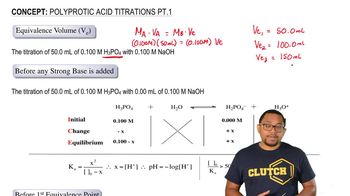
Polyprotic Acid Titrations
356
views
2
rank
Guided course
01:59
Polyprotic Acid Titrations
271
views
2
rank
Guided course
03:36
Polyprotic Acid Titrations
517
views
4
rank
Terms in this set (15)
Hide definitions
Polyprotic Acid
A substance capable of donating more than one proton, leading to multiple equivalence points during titration.
Equivalence Point
The stage in titration where stoichiometrically equal amounts of acid and base have reacted, resulting in complete neutralization.
Phosphoric Acid
A triprotic compound with three dissociation steps, each with a distinct acid dissociation constant.
Dihydrogen Phosphate
The intermediate anion formed after the first proton is removed from phosphoric acid during titration.
Hydrogen Phosphate
The anion produced after the second proton is removed from phosphoric acid, acting as a conjugate base.
Conjugate Base
The species formed when an acid donates a proton, capable of accepting a proton in reverse reactions.
ICE Chart
A tabular method for tracking initial, change, and equilibrium concentrations in acid-base reactions.
Quadratic Formula
A mathematical tool used to solve for unknown concentrations when the acid dissociation equation cannot be simplified.
Henderson-Hasselbalch Equation
A formula relating pH, pKa, and the ratio of conjugate base to weak acid, useful for buffer calculations.
Buffer System
A solution containing appreciable amounts of weak acid and its conjugate base, resisting pH changes upon small additions of acid or base.
Dissociation Constant
A value (Ka) quantifying the extent to which an acid releases protons in solution, with separate values for each proton in polyprotic acids.
pOH
A measure of hydroxide ion concentration, calculated as the negative logarithm of [OH−], used to find pH in basic solutions.
Titrant
A solution of known concentration, typically a strong base or acid, added to react with an analyte during titration.
Formal Concentration
The total concentration of a species in solution, accounting for dilution after mixing acid and base volumes.
Conservation of Mass
A principle ensuring that the total amount of matter remains constant throughout the titration process, guiding stoichiometric calculations.
 BackBack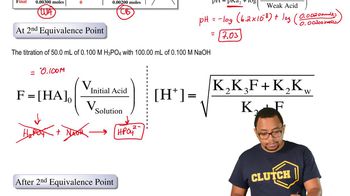
 01:50
01:50