What is a polyprotic acid and how does it differ from a monoprotic acid in titration?
A polyprotic acid can donate more than one proton (H+), resulting in multiple equivalence points during titration, unlike a monoprotic acid which has only one.
How many equivalence points are present in the titration of phosphoric acid with NaOH?
There are three equivalence points because phosphoric acid has three acidic hydrogens.
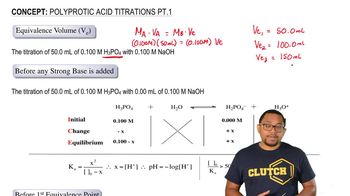
What is the formula used to calculate the equivalence volume of titrant in a titration?
Molarity of acid × volume of acid = molarity of base × equivalence volume of base.
Which dissociation constant (Ka) is used to calculate the initial pH of phosphoric acid before any base is added?
Ka1, the first dissociation constant, is used to calculate the initial pH.
Why is the quadratic formula used in the initial pH calculation for phosphoric acid?
The quadratic formula is used because the 5% approximation is not valid, so the 'minus x' term cannot be ignored.
What is the pH of a 0.100 M phosphoric acid solution before any NaOH is added?
The pH is approximately 1.62.
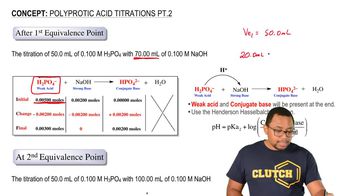
What forms in the solution before reaching the first equivalence point during the titration of phosphoric acid?
A buffer system forms, consisting of the weak acid and its conjugate base.
Which equation is used to calculate pH in the buffer region before the first equivalence point?
The Henderson-Hasselbalch equation is used.
At the first equivalence point, what species is present in the solution and which Ka is relevant for pH calculation?
The solution contains the conjugate base (dihydrogen phosphate), and Ka2 is used for pH calculation.
What is the pH at the first equivalence point in the titration of 0.100 M phosphoric acid with NaOH?
The pH is approximately 4.70.
After the first equivalence point but before the second, which dissociation constant is used in pH calculations?
Ka2 is used, as the second proton is being titrated.
What is the pH at the second equivalence point during the titration of phosphoric acid?
The pH is approximately 9.66.
How is the pH calculated after passing the second equivalence point when excess NaOH is present?
The pOH is calculated from the concentration of excess NaOH, then subtracted from 14 to find the pH.
What is the pH after passing the second equivalence point with excess NaOH in the titration of phosphoric acid?
The pH is approximately 11.96.
Why do strong bases like NaOH have a greater impact on pH than conjugate bases after the second equivalence point?
Strong bases fully dissociate and dominate the pH, whereas conjugate bases are weaker and have less effect.
 Back
Back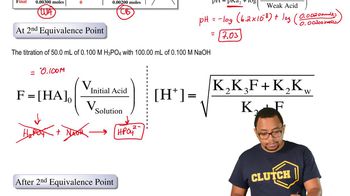
 01:50
01:50