Skip to main content
Analytical Chemistry
My Course
Learn
Exam Prep
AI Tutor
Study Guides
Flashcards
Explore
Try the app
My Course
Learn
Exam Prep
AI Tutor
Study Guides
Flashcards
Explore
Try the app
Back
Precision and Accuracy definitions
You can tap to flip the card.
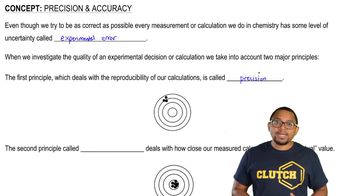
Experimental Error
You can tap to flip the card.
👆
Experimental Error
Represents the unavoidable uncertainty present in all measurements and calculations in chemistry.
Track progress
Control buttons has been changed to "navigation" mode.
1/14
Related flashcards
Related practice
Recommended videos
Precision and Accuracy quiz
Precision and Accuracy
15 Terms
Precision and Accuracy
3. Experimental Error
5 problems
Topic
Types of Errors
3. Experimental Error
5 problems
Topic
3. Experimental Error - Part 1 of 2
4 topics
12 problems
Chapter
3. Experimental Error - Part 2 of 2
3 topics
9 problems
Chapter
Guided course
01:30
Precision and Accuracy
403
views
6
rank
Guided course
02:59
Precision and Accuracy
497
views
8
rank
Terms in this set (14)
Hide definitions
Experimental Error
Represents the unavoidable uncertainty present in all measurements and calculations in chemistry.
Uncertainty
Describes the inherent doubt or variability associated with any measured or calculated value.
Precision
Reflects how closely repeated measurements or results agree with each other, indicating reproducibility.
Accuracy
Indicates how close a measured or calculated value is to the actual or true value.
Reproducibility
Measures the consistency of results when an experiment or calculation is repeated under the same conditions.
True Value
Represents the actual, accepted, or correct value that measurements aim to approximate.
Standard Deviation
Quantifies the spread of repeated measurements, providing a numerical measure of precision.
Data Quality
Assesses the reliability and usefulness of experimental results based on accuracy and precision.
Stoichiometry
Involves calculations based on chemical equations, where reliable results depend on accurate and precise measurements.
Acid–Base Reaction
A chemical process where understanding measurement reliability is crucial for interpreting outcomes.
Titration
An experimental technique where the evaluation of measurement reliability is essential for correct results.
Calculation
A process in chemistry that is always subject to some degree of error and uncertainty.
Bull's Eye
Serves as a metaphor for the true value in visual representations of accuracy.
Measurement
A value obtained experimentally, always accompanied by some level of uncertainty.
 BackBack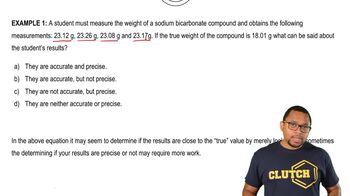
 01:30
01:30