Skip to main content
Analytical Chemistry
My Course
Learn
Exam Prep
AI Tutor
Study Guides
Flashcards
Explore
Try the app
My Course
Learn
Exam Prep
AI Tutor
Study Guides
Flashcards
Explore
Try the app
Back
The pH Scale quiz
You can tap to flip the card.
What is the typical range of the pH scale under normal conditions?
You can tap to flip the card.
👆
What is the typical range of the pH scale under normal conditions?
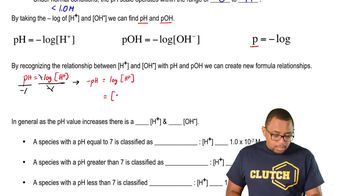
The pH scale typically ranges from 0 to 14 when the concentrations of H+ and OH- are less than 1 Molar.
Track progress
Control buttons has been changed to "navigation" mode.
1/15
Related flashcards
Related practice
Recommended videos
The pH Scale definitions
The pH Scale
14 Terms
The pH Scale
6. Chemical Equilibrium
5 problems
Topic
Acid Strength
6. Chemical Equilibrium
5 problems
Topic
6. Chemical Equilibrium - Part 1 of 3
4 topics
12 problems
Chapter
6. Chemical Equilibrium - Part 2 of 3
4 topics
12 problems
Chapter
6. Chemical Equilibrium - Part 3 of 3
2 topics
6 problems
Chapter
Guided course
04:25
pH and pOH Calculations 1
592
views
Guided course
05:18
pH and pOH
458
views
1
rank
Guided course
02:55
pH and pOH
317
views
2
rank
Terms in this set (15)
Hide definitions
What is the typical range of the pH scale under normal conditions?
The pH scale typically ranges from 0 to 14 when the concentrations of H+ and OH- are less than 1 Molar.
How is pH mathematically defined in terms of hydrogen ion concentration?
pH is defined as the negative logarithm of the hydrogen ion concentration: pH = -log[H+].
What does pOH represent and how is it calculated?
pOH is the negative logarithm of the hydroxide ion concentration: pOH = -log[OH-].
What is the relationship between pH and pOH in aqueous solutions?
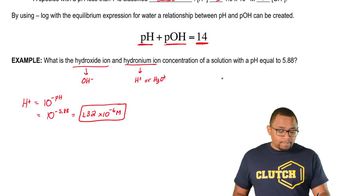
The relationship is pH + pOH = 14.
What is the ion product constant for water (Kw) at 25°C?
Kw is 1.0 x 10^-14 at 25 degrees Celsius.
What are the concentrations of H+ and OH- ions in a neutral solution at 25°C?
Both H+ and OH- concentrations are 1.0 x 10^-7 Molar at neutral pH.
How can you calculate [H+] if you know the pH?
You calculate [H+] by taking the antilog: [H+] = 10^-pH.
How can you calculate [OH-] if you know the pOH?
You calculate [OH-] by taking the antilog: [OH-] = 10^-pOH.
What does a pH greater than 7 indicate about a solution?
A pH greater than 7 indicates the solution is basic, with [OH-] greater than [H+].
What does a pH less than 7 indicate about a solution?
A pH less than 7 indicates the solution is acidic, with [H+] greater than [OH-].
What does a pH of exactly 7 indicate about the solution?
A pH of 7 indicates a neutral solution where [H+] equals [OH-].
What happens to [H+] and [OH-] as pH increases?
As pH increases, [H+] decreases and [OH-] increases, making the solution more basic.
If [H+] is greater than 1 M, what can you say about the pH?
If [H+] is greater than 1 M, the pH will be less than 0.
If [OH-] is greater than 1 M, what can you say about the pH?
If [OH-] is greater than 1 M, the pH will be greater than 14.
How are pH and pOH related to the ion product constant for water (Kw)?
Since Kw = [H+][OH-], and pH + pOH = 14, knowing sopH or pOH allows calculation of the other and the ion concentrations.
 BackBack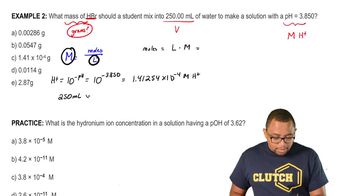
 04:25
04:25