Anatomy & Physiology
My Course
Learn
Exam Prep
AI Tutor
Study Guides
Textbook Solutions
Flashcards
Explore
My Course
Learn
Exam Prep
AI Tutor
Study Guides
Textbook Solutions
Flashcards
Explore
Back
Activation Pathways of the Complement System definitions
You can tap to flip the card.
Complement System
You can tap to
flip the card.
👆
Complement System
A part of the immune system that enhances the ability of antibodies and phagocytic cells to clear microbes and damaged cells.
Track progress
Control buttons has been changed to "navigation" mode.
1/15
Related flashcards
Recommended videos
Guided course
4:40
Alternative Pathway
Bruce Bryan
772
views
10
rank
Guided course
3:04
Lectin Pathway
Bruce Bryan
723
views
10
rank
Guided course
3:42
Classical Pathway
Bruce Bryan
671
views
7
rank
Terms in this set (15)
Hide definitions
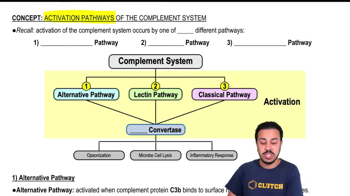
Complement System
A part of the immune system that enhances the ability of antibodies and phagocytic cells to clear microbes and damaged cells.
Alternative Pathway
A complement activation pathway triggered by C3b binding to microbial surfaces, leading to immune responses.
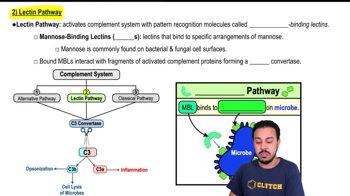
Lectin Pathway
A complement activation pathway using mannose-binding lectins to recognize specific carbohydrate patterns on microbes.
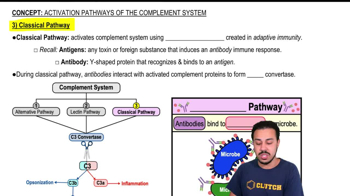
Classical Pathway
A complement activation pathway initiated by antibodies binding to antigens on microbial surfaces.
C3 Convertase
An enzyme complex that cleaves C3 into C3a and C3b, crucial for complement system activation.
C3a
A fragment of C3 that promotes inflammation as part of the immune response.
C3b
A fragment of C3 that binds to microbes, leading to opsonization or cell lysis.
Mannose-Binding Lectins
Proteins that bind to mannose on microbial surfaces, initiating the lectin pathway.
Antibodies
Y-shaped proteins produced by adaptive immunity that bind to antigens on microbes.
Antigens
Substances that induce an immune response, often by binding to antibodies.
Opsonization
The process by which pathogens are marked for ingestion and destruction by phagocytes.
Cell Lysis
The breaking down of a cell, often by the rupture of the cell membrane.
Inflammation
A biological response to harmful stimuli, characterized by redness, swelling, and pain.
Innate Immunity
The non-specific first line of defense against pathogens, including the complement system.
Adaptive Immunity
The immune system's ability to recognize and remember specific pathogens for more efficient responses.