Amino Acid Oxidation definitions Flashcards

Amino Acid Oxidation definitions
Control buttons has been changed to "navigation" mode.
1/15
  • Urea Cycle
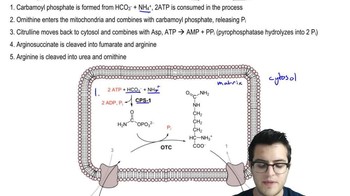
    A liver process converting two nitrogens into one urea molecule, utilizing ATP, to safely excrete nitrogen.
  • Glutamine
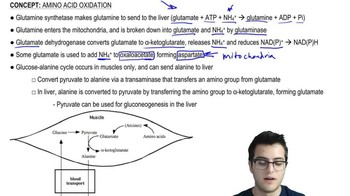
    An amino acid transported from tissues to the liver, converted to glutamate, releasing ammonium for the urea cycle.
  • Glutamate
    Formed from glutamine in the liver, it is converted to alpha-ketoglutarate, releasing ammonium for the urea cycle.
  • Alpha-ketoglutarate
    A product of glutamate dehydrogenation, involved in the release of ammonium for the urea cycle.
  • Glucose-Alanine Cycle
    A process where muscles send alanine to the liver, linking amino acid metabolism with gluconeogenesis.
  • Transaminases
    Enzymes facilitating amino group transfer, indicating tissue damage, especially in liver and heart.
  • Carbamoyl Phosphate
    A molecule formed in the mitochondria, initiating the urea cycle by combining with ornithine.
  • Ornithine
    A molecule entering mitochondria to combine with carbamoyl phosphate, forming citrulline in the urea cycle.
  • Citrulline
    A molecule formed in the urea cycle, exiting mitochondria to combine with aspartate, forming argininosuccinate.
  • Argininosuccinate
    A molecule in the urea cycle cleaved into fumarate and arginine, linking to the citric acid cycle.
  • Fumarate
    A byproduct of the urea cycle, entering the citric acid cycle to be converted into malate and oxaloacetate.
  • Aspartate
    Formed from glutamate and oxaloacetate, it combines with citrulline in the urea cycle.
  • N-Acetylglutamate
    A molecule stimulating carbamoyl phosphate synthetase, regulating the urea cycle.
  • Glutaminase
    An enzyme converting glutamine to glutamate, releasing ammonium for the urea cycle.
  • Glutamate Dehydrogenase
    An enzyme converting glutamate to alpha-ketoglutarate, releasing ammonium and reducing NAD+ or NADP+.