Pearson+ LogoPearson+ Logo
Back

Antibodies quiz #1

Control buttons has been changed to "navigation" mode.
1/10
  • What is the name of the test that measures blood levels of antibodies specific to particular antigens, and what does its result indicate?

    A serological test measures blood levels of antibodies specific to particular antigens. The presence and amount of these antibodies indicate whether the immune system has responded to or been exposed to those antigens.
  • What type of cell produces antibodies in the immune system?

    Plasma cells produce antibodies in the immune system. These cells are derived from B lymphocytes.
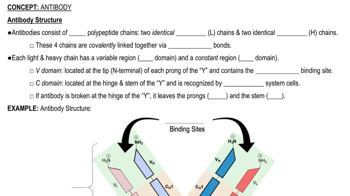
  • What are the two types of polypeptide chains found in an antibody, and how do they differ?

    Antibodies contain two identical light chains and two identical heavy chains. The heavy chains are larger and heavier than the light chains.
  • How are the four polypeptide chains in an antibody held together?

    The four polypeptide chains in an antibody are covalently linked by disulfide bonds. These bonds form between the cysteine residues of the chains.
  • Where is the variable region (V domain) located on an antibody, and what is its significance?

    The variable region is located at the tips of the Y-shaped antibody. It contains the antigen binding site and varies between different antibodies.
  • What is the function of the constant region (C domain) in an antibody?

    The constant region is recognized by immune system cells. It remains unchanged across different antibodies and is located at the hinge and stem of the Y.
  • What are the FAB and FC regions of an antibody, and how are they formed?

    The FAB region is the top half containing the antigen binding sites, while the FC region is the bottom half containing the constant region. They are formed if the antibody is split at the hinge.
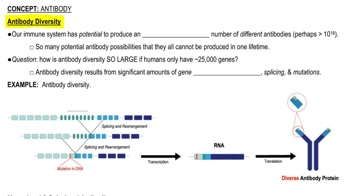
  • Why is antibody diversity so vast despite humans having only about 25,000 genes?

    Antibody diversity is vast because of gene rearrangements, splicing, and mutations. These processes allow the immune system to produce up to 1 quintillion different antibodies.
  • How can a single mutation in the DNA coding for antibodies affect antibody diversity?

    A single mutation in the DNA can result in a different antibody being produced. This contributes to the overall diversity of antibodies.
  • What is the estimated number of different antibodies the human immune system can potentially produce?

    The human immune system can potentially produce more than 1 quintillion (10^18) different antibodies. This number far exceeds the number of genes in the human genome.