What molecule supplies the energy for muscle contraction?
ATP (Adenosine Triphosphate) supplies the energy for muscle contraction by releasing energy through ATP hydrolysis, which is used to power cellular activities including muscle movement.
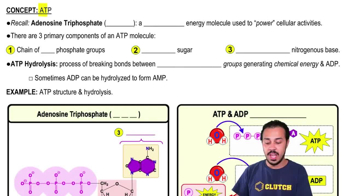
What are the three main components of an ATP molecule?
ATP consists of a chain of three phosphate groups, a pentose sugar, and an adenine nitrogenous base. The pentose sugar and adenine together form the adenosine portion of ATP.
What does the 'tri' in adenosine triphosphate refer to?
The 'tri' in adenosine triphosphate refers to the three phosphate groups attached in a chain. This distinguishes ATP from ADP and AMP, which have two and one phosphate groups, respectively.
How does ATP hydrolysis provide energy for cellular activities?
ATP hydrolysis breaks the bonds between phosphate groups using water, releasing energy that the cell can use. This process also produces ADP and a free phosphate group.
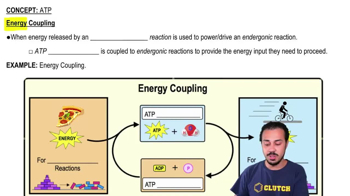
What is energy coupling in the context of ATP?
Energy coupling is when the energy released from an exergonic reaction, like ATP hydrolysis, is used to drive an endergonic reaction that requires energy input. This allows cells to use ATP hydrolysis to power processes such as building molecules or generating movement.
What are the products of ATP hydrolysis?
The products of ATP hydrolysis are ADP, a free phosphate group, and released energy. This energy is then available to power other cellular reactions.
How is the energy in food ultimately used by our muscles?
The energy in food is converted into chemical energy in the form of ATP through exergonic reactions. ATP hydrolysis then provides the energy needed for muscle contractions and movement.
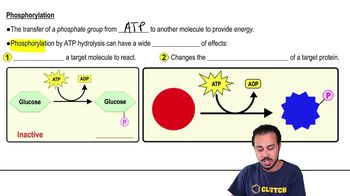
What is phosphorylation and what molecule usually donates the phosphate group?
Phosphorylation is the transfer of a phosphate group from ATP to another molecule. ATP is usually the donor of the phosphate group in this process.
How can phosphorylation affect a target protein?
Phosphorylation can change the conformation, or shape, of a target protein. This often alters the protein's function or activity within the cell.
Can phosphorylation both activate and inactivate molecules?
Yes, phosphorylation can lead to activation in some cases and inactivation in others. The effect depends on the specific molecule and context within the cell.