Back

Biological Membranes quiz #1

Control buttons has been changed to "navigation" mode.
1/40
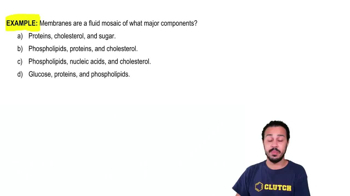
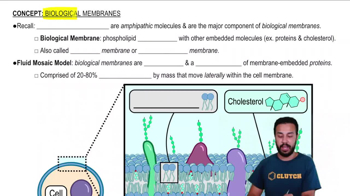
  • What is the correct description of a typical plasma membrane?

    It is a fluid mosaic of phospholipids, proteins, and cholesterol.
  • Which molecule is not one of the four main components of all plasma membranes?

    Nucleic acids
  • Where is cholesterol most likely located in an animal cell?

    Embedded within the plasma membrane
  • Which of these is the double membrane that encloses the nucleus? A) Plasma membrane B) Nuclear envelope C) Mitochondrial membrane D) Endoplasmic reticulum

    B) Nuclear envelope
  • What is the function of cholesterol in the cell membrane?

    Cholesterol helps to maintain membrane fluidity and stability.
  • The tails of the phospholipids of the plasma membrane are composed of _____ and are _______? A) Fatty acids; hydrophobic B) Glycerol; hydrophilic C) Amino acids; hydrophilic D) Sugars; hydrophobic

    A) Fatty acids; hydrophobic
  • Which molecule does not move freely across the cytoplasmic membrane?

    Glucose
  • In what way will cholesterol influence the cell membrane?

    Cholesterol modulates the fluidity and stability of the cell membrane.
  • What is a function of the plasma membrane?

    Selective permeability
  • What is a function of the cell membrane?

    Selective permeability
  • Which molecule is not a constituent of a plasma membrane?

    DNA
  • What is a characteristic of the cell membrane?

    Fluid and dynamic
  • Which molecule is found in the membrane of an animal cell?

    Cholesterol
  • What is the function of cholesterol in the plasma membrane?

    Cholesterol helps to maintain the fluidity and integrity of the plasma membrane.
  • What is the function of the cell wall?

    Provides structural support and protection
  • What is the purpose of cholesterol in the cell membrane?

    Cholesterol stabilizes the membrane and maintains its fluidity.
  • What is the name of the highlighted membrane? A) Plasma membrane B) Nuclear envelope C) Mitochondrial membrane D) Endoplasmic reticulum

    A) Plasma membrane
  • Why does a plasma membrane act as a barrier to the free passage of water-soluble substances?

    The hydrophobic core of the phospholipid bilayer prevents water-soluble substances from passing freely.
  • What does the outer membrane of a gram-negative cell contain?

    Lipopolysaccharides
  • Besides phospholipids, what is the plasma membrane made up of?

    Proteins
  • What is the permeability characteristic of the cell membrane?

    It is selectively permeable.
  • How is the structure of the plasma membrane best described?

    A fluid mosaic of lipids and proteins
  • What are the cell surface markers included in the plasma membrane?

    C) Glycoproteins
  • What is one of the main functions of the membrane's phospholipid bilayer?

    C) Acting as a barrier to water-soluble substances
  • What are the 3 factors that lead to membrane fluidity of the plasma membrane?

    The presence of cholesterol, the unsaturated fatty acid tails of phospholipids, and the lateral movement of proteins.
  • What is a characteristic of the plasma membrane?

    C) Fluid and flexible
  • What property of the phospholipid bilayer allows proteins to move laterally in the membrane?

    The fluid nature of the phospholipid bilayer allows lateral movement of proteins.
  • What property does the plasma membrane have regarding permeability?

    C) Selectively permeable
  • Which of these are not embedded in the hydrophobic portion of the lipid bilayer at all? A) Integral proteins B) Peripheral proteins C) Cholesterol D) Phospholipids

    B) Peripheral proteins
  • Which molecule is not a component of the plasma membrane?

    C) DNA
  • What is true about the membrane on an enveloped virus?

    B) It is derived from the host cell's membrane.
  • What are functions of the selectively permeable plasma membrane?

    Regulating the entry and exit of substances, maintaining homeostasis, and facilitating communication and signaling.
  • What type of molecules can cross the plasma membrane due to its selective permeability?

    C) Small nonpolar molecules
  • What is this structure? What membrane covers it? A) Nucleus; nuclear envelope B) Mitochondrion; mitochondrial membrane C) Chloroplast; chloroplast membrane D) Ribosome; ribosomal membrane

    A) Nucleus; nuclear envelope
  • What structure protects the contents of the nucleus?

    B) Nuclear envelope
  • What is true about membrane filters regarding their permeability?

    They allow selective passage of substances.
  • In which cellular structure is a lipid membrane present?

    Plasma membrane
  • What is a major role of the glycocalyx of the cell membrane?

    Cell recognition and protection
  • Which function is not performed by the plasma membrane?

    Energy production
  • Which molecule is not a component of the plasma membrane?

    DNA