Skip to main content
Anatomy & Physiology
My Course
Learn
Exam Prep
AI Tutor
Study Guides
Textbook Solutions
Flashcards
Explore
Try the app
My Course
Learn
Exam Prep
AI Tutor
Study Guides
Textbook Solutions
Flashcards
Explore
Try the app
Back
Capillaries quiz
You can tap to flip the card.
Why do capillaries need to be thin-walled?
You can tap to flip the card.
👆
Why do capillaries need to be thin-walled?
Capillaries need to be thin-walled to facilitate efficient exchange of nutrients and gases between blood and tissues.
Track progress
Control buttons has been changed to "navigation" mode.
1/10
Related flashcards
Related practice
Recommended videos
Capillaries definitions
Capillaries
15 Terms
Capillaries quiz #1
Capillaries
10 Terms
Capillaries
19. The Blood Vessels
6 problems
Topic
Jason
Veins
19. The Blood Vessels
6 problems
Topic
Jason
19. The Blood Vessels - Part 1 of 2
4 topics
10 problems
Chapter
Jason
19. The Blood Vessels - Part 2 of 2
4 topics
9 problems
Chapter
Bruce
Guided course
9:42
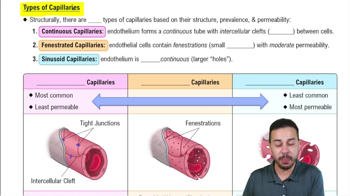
Types of Capillaries
5171
views
95
rank
1
comments
Guided course
5:59
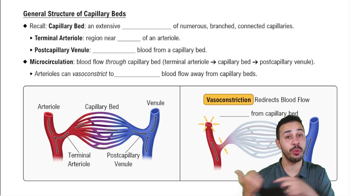
General Structure of Capillary Beds
4528
views
77
rank
Guided course
6:52
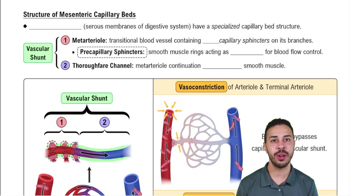
Structure of Mesenteric Capillary Beds
4419
views
70
rank
Terms in this set (10)
Hide definitions
Why do capillaries need to be thin-walled?
Capillaries need to be thin-walled to facilitate efficient exchange of nutrients and gases between blood and tissues.
How thick are the walls of the alveoli and the capillaries?
The walls of both alveoli and capillaries are extremely thin, consisting of a single layer of cells to allow for efficient gas exchange.
What is not true about capillaries?
They have thick walls is not true; capillaries have thin walls consisting only of the tunica intima.
What is a primary function of capillaries?
Facilitating nutrient and gas exchange is a primary function of capillaries.
Which are the thinnest blood vessels?
Capillaries are the thinnest blood vessels, consisting only of the tunica intima.
What is the diameter range of capillaries?
Capillaries have a diameter range of about 5 to 10 micrometers.
What are the three types of capillaries?
The three types of capillaries are continuous, fenestrated, and sinusoid.
Where are fenestrated capillaries commonly found?
Fenestrated capillaries are commonly found in the kidneys, endocrine glands, and small intestines.
What is the function of precapillary sphincters?
Precapillary sphincters regulate blood flow into capillary beds by contracting to restrict flow.
What is microcirculation?
Microcirculation refers to the blood flow through capillary beds from terminal arterioles to postcapillary venules.
 BackBack

 9:42
9:42