Skip to main content
Anatomy & Physiology
My Course
Learn
Exam Prep
AI Tutor
Study Guides
Textbook Solutions
Flashcards
Explore
Try the app
My Course
Learn
Exam Prep
AI Tutor
Study Guides
Textbook Solutions
Flashcards
Explore
Try the app
Back
Cardiac Action Potentials definitions
You can tap to flip the card.
Pacemaker cells
You can tap to flip the card.
👆
Pacemaker cells
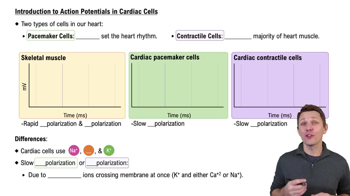
Heart cells that set the rhythm through autorhythmicity, initiating action potentials without external signals.
Track progress
Control buttons has been changed to "navigation" mode.
1/15
Related flashcards
Related practice
Recommended videos
Cardiac Action Potentials quiz
Cardiac Action Potentials
10 Terms
Cardiac Action Potentials quiz #1
Cardiac Action Potentials
11 Terms
Cardiac Action Potentials
18. The Heart
7 problems
Topic
Jason
Electrocardiogram (ECG)
18. The Heart
4 problems
Topic
Jason
18. The Heart
4 topics
11 problems
Chapter
Jason
4:08
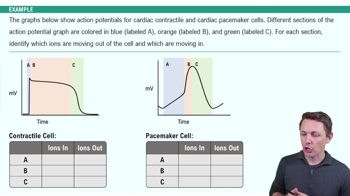
Cardiac Action Potentials Example 4
4936
views
72
rank
7:18
Introduction to Action Potential in Cardiac Cells
8751
views
150
rank
2
comments
6:36
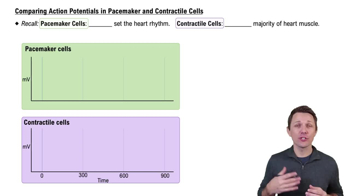
Comparing Action Potentials in Pacemaker and Contractile Cells
4812
views
109
rank
1
comments
Terms in this set (15)
Hide definitions
Pacemaker cells
Heart cells that set the rhythm through autorhythmicity, initiating action potentials without external signals.
Contractile cells
Heart cells responsible for contraction and blood pumping, experiencing rapid depolarization and a plateau phase.
Depolarization
A phase where the cell's membrane potential becomes less negative, often due to sodium or calcium ion inflow.
Repolarization
The process of restoring the cell's membrane potential to a negative value after depolarization.
Plateau phase
A phase in cardiac action potentials where depolarization is prolonged due to calcium inflow and potassium outflow.
Autorhythmicity
The ability of pacemaker cells to generate action potentials independently, setting the heart's rhythm.
Sodium ions
Positively charged ions that contribute to depolarization by entering the cell.
Calcium ions
Positively charged ions that prolong depolarization in cardiac cells by entering the cell.
Potassium ions
Positively charged ions that contribute to repolarization by exiting the cell.
Absolute refractory period
A period during which cardiac cells cannot respond to new action potentials, ensuring relaxation.
Pacemaker potential
The slow depolarization phase in pacemaker cells that initiates action potentials.
Intrinsic cardiac conduction system
The system responsible for initiating and spreading action potentials throughout the heart.
Gap junctions
Channels that allow action potentials to pass directly from one cardiac cell to another.
Millivolts
A unit of measurement for electrical potential used to describe changes in membrane potential.
Resting potential
The stable, negative membrane potential of a cell when it is not being stimulated.
 BackBack
 4:08
4:08