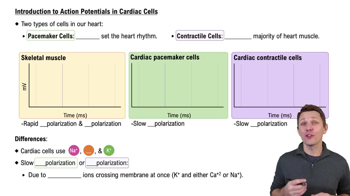
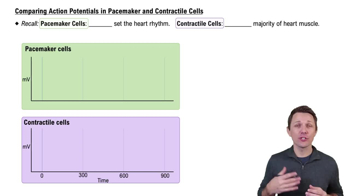
What are the key differences between the action potentials of cardiac pacemaker cells and cardiac contractile cells, and how do these differences contribute to the heart's function?
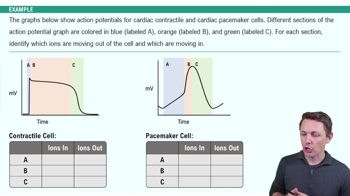
Cardiac pacemaker cells have a slow depolarization phase (pacemaker potential) due to simultaneous sodium inflow and potassium outflow through the same channel, which sets the heart's rhythm (autorhythmicity). They lack a true resting potential and continuously cycle through depolarization and repolarization. In contrast, cardiac contractile cells have a rapid depolarization (from sodium inflow), followed by a plateau phase where calcium inflow and slow potassium outflow prolong depolarization, extending the absolute refractory period. This ensures the heart muscle fully contracts and relaxes between beats, preventing tetany and allowing effective blood pumping.
 Back
Back
 4:08
4:08