Back

Cell Junctions quiz

Control buttons has been changed to "navigation" mode.
1/18
  • Which of these cell junctions form a barrier to the passage of materials?

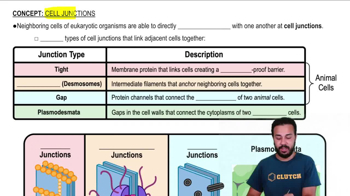
    Tight junctions form a barrier to the passage of materials by creating leak-proof barriers between cells.
  • What do intercellular junctions connect?

    Intercellular junctions connect adjacent eukaryotic cells, allowing them to interact and communicate with each other.
  • What is the function of tight junctions?

    They create leak-proof barriers
  • How are tight junctions best described?

    Membrane proteins that create leak-proof barriers
  • Which type of junctions must there be between cells to form a barrier?

    Tight junctions must be present between cells to form a barrier.
  • What is the description of a desmosome?

    Desmosomes, or anchoring junctions, are complex protein structures that anchor neighboring cells together using intermediate filaments.
  • What type of cell junctions are found in cardiac muscle tissue?

    Gap junctions and desmosomes are found in cardiac muscle tissue, allowing for communication and mechanical stability.
  • What do gap junctions do in animals?

    Gap junctions in animals create protein channels that connect the cytoplasm of two cells, allowing for the exchange of nutrients and other substances.
  • What is the function of intercalated discs?

    Intercalated discs contain gap junctions and desmosomes, facilitating electrical and mechanical coupling between cardiac muscle cells.
  • Which is the function of an intercalated disc?

    The function of an intercalated disc is to connect cardiac muscle cells, allowing for synchronized contraction through electrical and mechanical coupling.
  • What are intercalated discs?

    Intercalated discs are specialized structures in cardiac muscle tissue that contain gap junctions and desmosomes, enabling coordinated contraction.
  • Which substances can pass through a gap junction?

    Ions
  • Which appendage provides the ability to attach to surfaces and other cells?

    Pili, found in bacteria, provide the ability to attach to surfaces and other cells.
  • Which type of cell junction is responsible for movement of molecules between cells?

    Gap junctions are responsible for the movement of molecules between cells by allowing direct cytoplasmic connections.
  • Which cell junction allows for rapid and direct communication between two cells?

    C) Gap junctions
  • Which cell junctions prevent substances from passing between adjacent cells?

    Tight junctions prevent substances from passing between adjacent cells by creating a seal.
  • The type of membrane junction that prevents material from moving in-between cells is called?

    The type of membrane junction that prevents material from moving in-between cells is called a tight junction.
  • What are the functions of anchoring junctions?

    Anchoring junctions, or desmosomes, function to mechanically attach cells to each other, providing structural support and stability.