Cellular Respiration: Krebs Cycle definitions Flashcards
Cellular Respiration: Krebs Cycle definitions
You can tap to flip the card.
Control buttons has been changed to "navigation" mode.
1/15
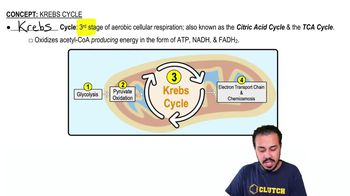
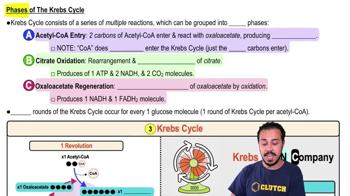
Krebs CycleThe third stage of aerobic respiration, oxidizing acetyl-CoA to produce ATP, NADH, and FADH2.Citric Acid CycleAnother name for the Krebs Cycle, emphasizing the production of citrate from acetyl-CoA and oxaloacetate.TCA CycleSynonym for the Krebs Cycle, highlighting its role in tricarboxylic acid metabolism.Acetyl-CoAA molecule that enters the Krebs Cycle, reacting with oxaloacetate to form citrate.OxaloacetateA four-carbon molecule that reacts with acetyl-CoA to form citrate in the Krebs Cycle.CitrateA six-carbon molecule formed in the Krebs Cycle from acetyl-CoA and oxaloacetate.NADHAn electron carrier produced in the Krebs Cycle, used in the electron transport chain.FADH2An electron carrier produced in the Krebs Cycle, contributing to ATP production in the ETC.ATPA small amount of energy currency produced in the Krebs Cycle via substrate-level phosphorylation.CO2A byproduct of the Krebs Cycle, released as a waste product during respiration.Phase AThe initial phase of the Krebs Cycle where acetyl-CoA enters and forms citrate.Phase BThe phase of the Krebs Cycle involving citrate oxidation, producing ATP, NADH, and CO2.Phase CThe final phase of the Krebs Cycle, regenerating oxaloacetate and producing NADH and FADH2.Electron Transport ChainThe final stage of aerobic respiration where NADH and FADH2 are used to produce ATP.Substrate-level PhosphorylationA process in the Krebs Cycle that directly generates ATP from ADP and a substrate.