Cellular Respiration: Pyruvate Oxidation definitions Flashcards

Cellular Respiration: Pyruvate Oxidation definitions
Control buttons has been changed to "navigation" mode.
1/10
  • Pyruvate
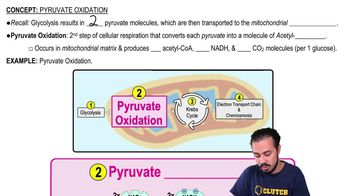
    A three-carbon molecule produced from glucose during glycolysis, transported to the mitochondrial matrix for oxidation.
  • Mitochondrial Matrix
    The innermost compartment of mitochondria where pyruvate oxidation occurs, converting pyruvate into Acetyl CoA.
  • Acetyl CoA
    A molecule formed from pyruvate during oxidation, which enters the Krebs cycle in cellular respiration.
  • NADH
    An electron carrier molecule produced during pyruvate oxidation when NAD+ gains electrons.
  • CO2
    A byproduct of pyruvate oxidation, formed when a carbon atom is removed from pyruvate.
  • Cellular Respiration
    A multi-step process including glycolysis, pyruvate oxidation, and the Krebs cycle, converting glucose into energy.
  • Glycolysis
    The first stage of cellular respiration, breaking down glucose into two pyruvate molecules.
  • Electrons
    Subatomic particles lost by pyruvate during oxidation, transferred to NAD+ to form NADH.
  • Krebs Cycle
    The third stage of cellular respiration, following pyruvate oxidation, where Acetyl CoA is further processed.
  • Aerobic
    A type of respiration requiring oxygen, encompassing glycolysis, pyruvate oxidation, and the Krebs cycle.