Change in Membrane Potential definitions Flashcards

Change in Membrane Potential definitions
Control buttons has been changed to "navigation" mode.
1/15
  • Resting membrane potential
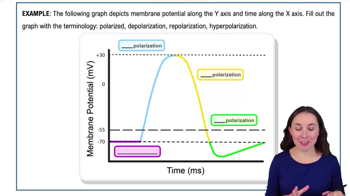
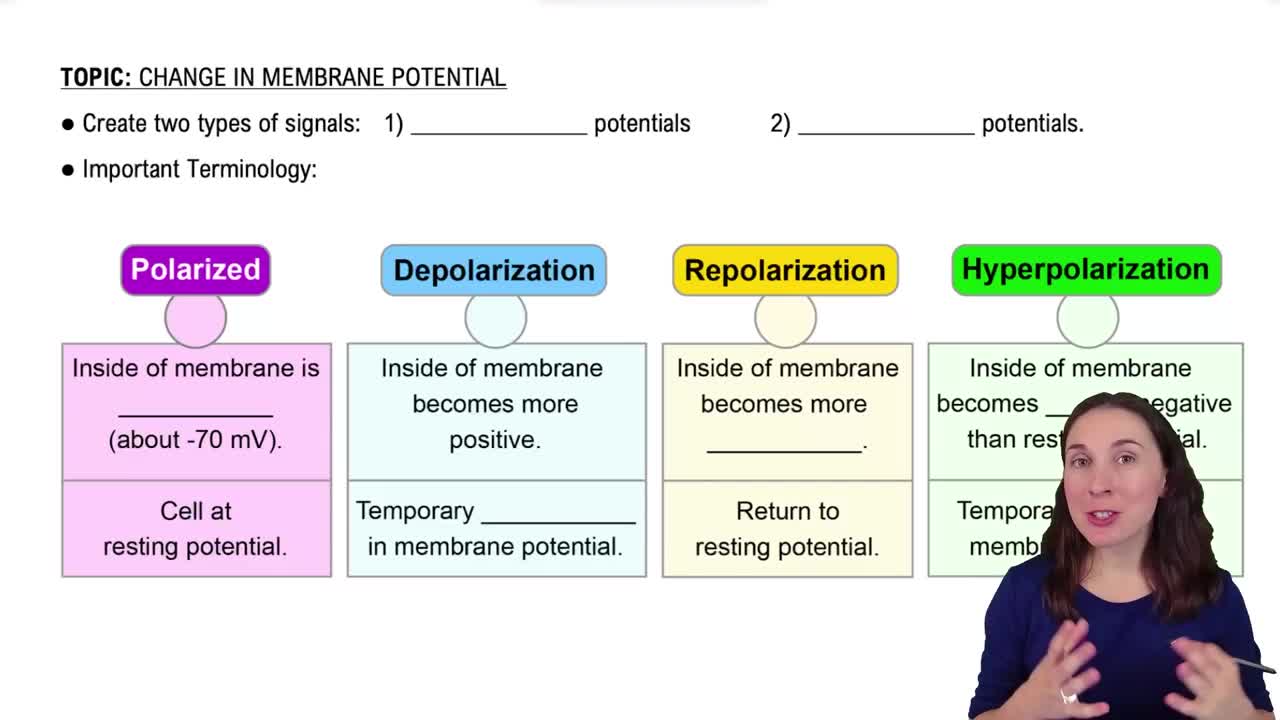
    The state where the inside of a neuron's membrane is negatively charged at -70 millivolts.
  • Graded potential
    A type of signal resulting from changes in membrane potential, varying in magnitude.
  • Action potential
    A type of signal resulting from changes in membrane potential, characterized by a rapid rise and fall.
  • Polarized
    The state of a neuron when the inside of the membrane is negative, typically at -70 millivolts.
  • Depolarization
    The process where the inside of the neuron's membrane becomes more positive, moving away from the resting potential.
  • Repolarization
    The process where the inside of the neuron's membrane becomes more negative, returning toward the resting potential.
  • Hyperpolarization
    The state where the inside of the neuron's membrane becomes more negative than the resting potential.
  • Neural communication
    The process by which neurons transmit signals through changes in membrane potential.
  • Membrane potential
    The electrical potential difference across a cell's membrane.
  • Negative 70 millivolts
    The typical value of the resting membrane potential in neurons.
  • Positive 20 millivolts
    An example value used to illustrate depolarization in neurons.
  • Temporary decrease
    A description of depolarization where membrane potential becomes less negative.
  • Temporary increase
    A description of hyperpolarization where membrane potential becomes more negative.
  • Negative sign
    Indicates a negative charge inside the neuron's membrane during resting potential or repolarization.
  • Positive sign
    Indicates a positive charge inside the neuron's membrane during depolarization.