Back

Change in Membrane Potential quiz

Control buttons has been changed to "navigation" mode.
1/10
  • Why does depolarization occur in a neuron?

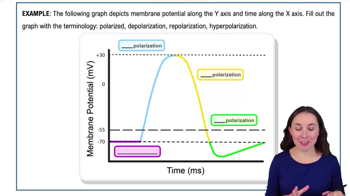
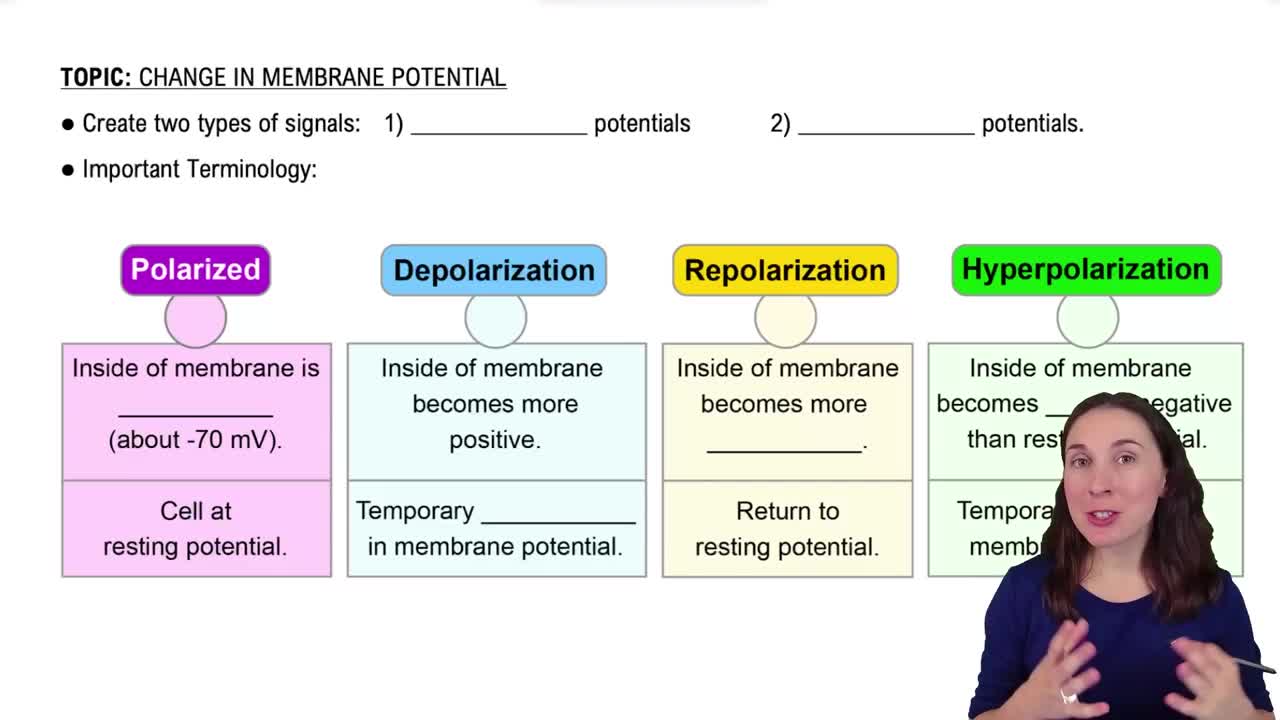
    Depolarization occurs when the inside of the neuron's membrane becomes more positive, moving away from the resting potential of -70 millivolts.
  • What ionic change is likely to cause depolarization of a neuron?

    Increase in positive ions inside the neuron
  • What happens when a resting neuron's membrane depolarizes?

    When a resting neuron's membrane depolarizes, the inside of the membrane becomes more positive, moving away from the resting potential.
  • How does a neuron cell membrane become depolarized?

    A neuron cell membrane becomes depolarized when positive ions enter the neuron, making the inside of the membrane more positive.
  • When a cell is stimulated, how does the membrane depolarize?

    When a cell is stimulated, positive ions flow into the cell, causing the membrane to depolarize and become more positive.
  • What is the resting membrane potential of a neuron?

    The resting membrane potential of a neuron is -70 millivolts.
  • What is repolarization in the context of membrane potential?

    Repolarization is the process where the membrane potential returns to a more negative state after depolarization, aiming to reach the resting potential.
  • What does hyperpolarization mean in terms of membrane potential?

    Hyperpolarization occurs when the membrane potential becomes more negative than the resting potential, often due to an overshoot during repolarization.
  • What are the two types of signals resulting from changes in membrane potential?

    The two types of signals are graded potentials and action potentials.
  • What does it mean for a neuron to be polarized?

    A neuron is polarized when the inside of its membrane is negatively charged, typically at -70 millivolts, indicating it is at rest.